
When I Stopped Trying to Explain Everything
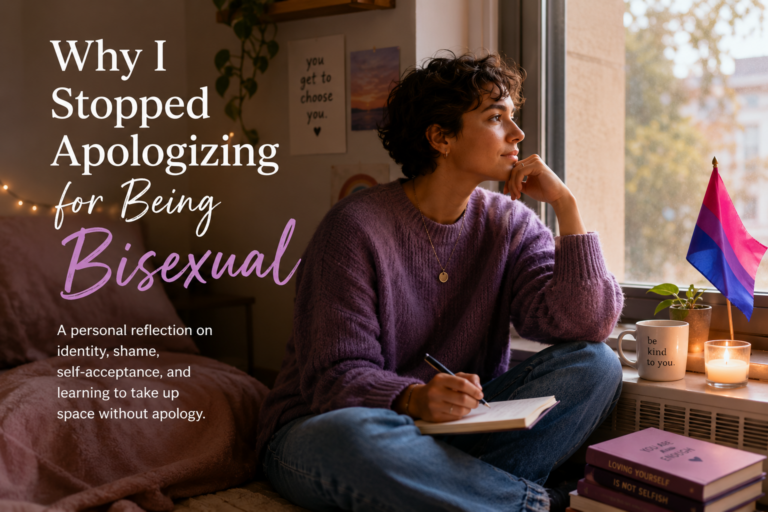
A quiet personal reflection about bisexuality, self-acceptance, and the relief of no longer needing to justify every feeling.
For a long time, I thought understanding myself meant being able to explain myself perfectly. Not just to other people, but to myself.
I thought I needed the right words, the right label, and the right sequence of realizations that would suddenly make everything feel neat and certain. I kept waiting for the moment when my identity would become easy to describe, easy to defend, and easy to fit into a sentence no one would question.
That moment never came.
What came instead was something quieter.
I started noticing how much energy I was spending trying to make myself make sense to people who were only comfortable with simple answers. Too straight for some spaces. Too queer for others. Too emotional. Too uncertain. Too much. Or somehow not enough.
The pressure to explain everything
For a while, I believed that if I could just explain myself better, people would understand.
But the truth is, some people are not confused because you are unclear.
They are confused because you do not fit the version of the world they find easiest.
Realizing that changed something in me.
I began to see how often bisexuality is treated like a phase, a contradiction, or a temporary stop on the way to a more acceptable conclusion. I also noticed how often people expected certainty from me when they had never had to question their own assumptions in the first place.
Slowly, I stopped feeling responsible for making my existence easy for everyone else.
Why I stopped trying to explain everything
That did not happen overnight.
It happened in small moments.
In some conversations, I chose honesty over comfort.
At other times, I felt the quiet relief of reading someone else’s story and seeing parts of myself in it.
I began recognizing that attraction does not become less real just because it is layered.
I also began understanding that uncertainty is not failure. Complexity is not weakness. Needing time does not make anyone less valid.
Self-acceptance did not feel dramatic
There was a time when I thought self-acceptance would feel dramatic.
I imagined some grand turning point. Some perfect sentence. Some final clarity after years of confusion.
Instead, it felt more like exhaling.
More than anything, it felt like setting something down.
It felt like no longer arguing with myself for feelings I had already lived.
I stopped trying to prove that what I felt was serious enough, clear enough, consistent enough, or understandable enough.
The rehearsed explanations in my head began to fade before conversations had even happened.
Most importantly, I stopped assuming I owed everyone access to my inner life just because they asked a question with confidence.
If you are working through similar questions about identity, attraction, privacy, coming out, or how much you want to explain to other people, the BiFiles Support & FAQ offers short, practical guidance you can explore at your own pace.
The peace of not needing to explain everything
In that space, something softer began to grow.
Peace.
Not complete peace. Not permanent peace. But real peace.
The kind that comes when you stop treating yourself like a problem to solve.
The kind that comes when you allow your experience to be true before anyone else approves of it.
I still do not have an answer for every question people ask.
Sometimes I still hesitate.
There are also moments when I feel the old urge to make everything sound tidy and easy, to turn something deeply personal into something politely understandable.
But I know now that I do not need to explain everything in order for it to be real.
I do not need to perform certainty to deserve respect.
There is no need to simplify myself for someone else’s comfort.
And maybe that has been one of the most meaningful parts of this journey — not just learning who I am, but learning that I am allowed to belong to myself even when the explanation is incomplete.
There is freedom in that
There is freedom in that.
There is also grief in it, because part of self-acceptance means noticing how long you lived without that freedom. It means recognizing how often you made yourself smaller, quieter, easier to digest. It also means seeing how much time was spent trying to become understandable instead of becoming at ease.
But even that grief has changed for me.
It no longer feels like proof that something is wrong.
Now it feels like proof that something mattered.
Being seen matters.
Honesty matters too.
Spaces where people can speak without being reduced matter.
Stories matter as well.
Why personal stories matter
Maybe that is why personal reflection can be so powerful. Sometimes we do not need another perfect definition. Sometimes we just need to hear someone say, “This is how it felt for me,” and realize we are not alone in the messier, quieter parts of becoming ourselves.
If you want to read more reflections from bisexual people, you can explore more Personal Stories on BiFiles.
So no, I do not have a perfect explanation for everything.
I do not think I need one anymore.
What I have is something better.
I have a life that feels more honest than it used to.
The language I use now feels closer, even if it is still evolving.
There is also less fear of being misunderstood, because I no longer measure my worth by how quickly other people understand me.
And I have a growing trust in the fact that some truths do not become stronger by being simplified.
They become stronger by being lived.
Helpful external resources
For broader support around bisexual identity, self-acceptance, and LGBTQ+ well-being, you may also find resources from Bisexual Resource Center and The Trevor Project helpful.
Final reflection
If you are still in the part where you feel like you have to explain everything — to your friends, your family, your partner, your community, or even yourself — I hope this reminds you of something simple.
You are allowed to be real before you are easy to explain.
Sometimes, that is where acceptance truly begins.
Explore more from BiFiles
BiFiles Community Stories is part of the wider BiFiles Network — a calm place for bisexual and bi-curious people to find reflection, conversation, and community at their own pace.