Bisexuality, Trans People and Non-Binary Inclusion: What “Bi” Actually Means
Does being bisexual mean being attracted only to men and women? Does attraction to a trans or non-binary person make someone pansexual instead? And is bisexuality itself based on a gender binary?
Originally published by BiFiles: Bisexuality, Trans People and Non-Binary Inclusion: What “Bi” Actually Means — Original source: https://bifiles.com/sexuality-identity/bisexuality-trans-non-binary-inclusion/. © 2026 BiFiles. Free to read and share by link; republication requires permission except as permitted by law.
These questions come up often because several different ideas are being mixed together: sexual orientation, gender identity, the meaning of the word bisexual, and the overlap between bisexual and pansexual identities.
The short answer is simple: bisexuality does not inherently exclude trans or non-binary people. Being attracted to a trans or non-binary person also does not automatically change someone’s sexual orientation or require them to use a different label.
What does bisexual actually mean?
There is no requirement that bisexual attraction must be exactly equal, happen at the same time, or look the same across genders.
A useful contemporary definition is attraction to more than one gender. Stonewall uses “bi” as an umbrella term for romantic and/or sexual orientation toward more than one gender. Bisexual educator and activist Robyn Ochs similarly describes bisexuality as the potential for romantic and/or sexual attraction to people of more than one gender, without requiring that attraction to happen in the same way or to the same degree.
That leaves room for considerable variation. One bisexual person may experience attraction differently depending on gender. Another may feel that gender matters very little. Someone may have strong preferences, shifting patterns of attraction, or no neat pattern at all.
Bisexuality describes a capacity for attraction. It does not mean being attracted to every person, every gender, or everyone in the same way.
Does “bi” mean exactly two genders?
This is one of the most persistent sources of confusion.
It can seem intuitive to look at the prefix “bi” and conclude that bisexuality must mean attraction to exactly two genders. But identity labels develop through communities and history; their meaning cannot always be determined simply by breaking a word into its linguistic parts.
Importantly, the idea that bisexuality need not be limited to a strict gender binary is not a recent attempt to redefine the orientation.
Bisexual activists were explicitly challenging binary interpretations decades ago. The Bisexual Manifesto, associated with the Bay Area Bisexual Network and the magazine Anything That Moves in the early 1990s, warned readers not to assume that bisexuality was binary and specifically rejected the assumption that there are only two genders.
That does not mean every bisexual person throughout history has understood the word identically. They have not. It does show that inclusive and non-binary understandings of bisexuality have a substantial history within bisexual communities themselves.
Can bisexual people be attracted to trans people?
Yes.
A common misconception treats “trans” as though it were another gender alongside “man” and “woman.” But being transgender and being a man, woman, or another gender are not competing categories.
A trans woman is a woman. A trans man is a man. Being transgender describes a relationship between someone’s gender identity and the sex they were assigned at birth; it does not create a separate sexual orientation category.
Trans people themselves can also be bisexual, straight, gay, lesbian, queer, asexual, pansexual, or use other language for their orientation.
So a bisexual person being attracted to a trans man or trans woman does not somehow take them outside bisexuality.
What about non-binary people?
Bisexuality can include attraction to non-binary people too.
Non-binary is an umbrella term covering many experiences of gender that do not fit neatly or exclusively within “man” or “woman.” Non-binary people are not one single third gender, and they do not all understand their gender in the same way.
Someone can therefore be bisexual and attracted to men and non-binary people, women and non-binary people, multiple genders across and beyond the binary, or experience another pattern of attraction that makes bisexual the most useful label for them.
Again, this does not mean every bisexual person must be attracted to non-binary people. An inclusive definition of bisexuality describes what bisexuality can include; it does not prescribe who every bisexual individual must find attractive.
Can trans and non-binary people be bisexual themselves?
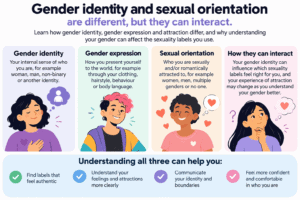
Yes. Trans and non-binary people are not only people a bisexual person might be attracted to; they can also be bisexual themselves. A trans woman, trans man, or non-binary person may identify as bisexual. Gender identity describes a person’s gender, while sexual orientation describes their patterns of attraction.
This is important within bisexual communities too. Inclusion means listening to trans and non-binary bisexual people as members with their own experiences, rather than discussing them only as possible partners. Their identities, privacy, boundaries, and perspectives deserve the same respect as anyone else’s.
Community discussions reviewed by BiFiles also highlight how some trans men and transmasculine people feel overlooked in LGBTQ+ conversations or struggle to find peers who understand their experiences. That need for recognition matters when someone is bisexual, too. Making room for trans men’s perspectives does not minimize the challenges faced by trans women or non-binary people; support should not become a competition over whose experiences count.
Respect Is Not Conditional on Appearance or Disclosure
Trans and non-binary bisexual people may encounter acceptance that depends on whether others think they “pass,” conform to conventional gender expectations, or look a particular way. A trans woman does not have to look conventionally feminine, undergo medical treatment, or meet someone else’s standards of beauty to be respected as a woman. No one’s gender should be treated as something other members get to approve.
Someone may also choose not to mention being trans in every introduction or community conversation. That boundary is not deception. Belonging in a bisexual space should not depend on disclosing medical history, explaining one’s body, or repeatedly defending one’s gender. Organizers and moderators can address deliberate misgendering, appearance-based gatekeeping, and intrusive questions without leaving the targeted person to argue for their own dignity.
Does attraction to a trans or non-binary person make me pansexual?
No. There is no automatic rule that changes someone from bisexual to pansexual because they are attracted to a trans or non-binary person.
This misconception sometimes appears as a simple formula: bisexual people are attracted to men and women, while pansexual people are attracted to men, women, trans people, and non-binary people.
That formula creates two problems. First, it incorrectly treats trans men and trans women as genders separate from men and women. Second, it erases bisexual people whose attraction includes non-binary people.
Bisexual and pansexual identities can overlap considerably. People also differ in how they personally understand those labels. That overlap deserves its own explanation rather than forcing everyone into one rigid distinction.
For now, the important point is that another person does not need to relabel your sexuality because of the gender or trans status of someone you are attracted to.
Why does this misconception keep appearing?
Part of the problem is that short definitions are easy to repeat. “Bi means two” and “pan means everyone” sounds clear, even when real identities and histories are more complicated.
Another problem is that people sometimes try to create a perfectly clean technical boundary between bisexual and pansexual identities. Lived experience is usually less tidy.
In conversations reviewed while developing this BiFiles guide, people described bisexuality in several ways: attraction to more than one gender, attraction to genders similar to and different from their own, attraction where gender can matter, or simply the label that best describes a long-standing part of themselves.
Trans and non-binary bisexual people also described their own bisexual identities — a straightforward reminder that bisexuality and gender diversity are not mutually exclusive.
Other people described moving between bisexual, pansexual, queer, or no label at different points in their lives, sometimes without a dramatic change in the underlying people they could be attracted to.
When definitions turn into label policing
Definitions can be useful. They give people language for experiences that might otherwise feel confusing or invisible.
But definitions become less helpful when they are used to tell someone that their identity is invalid because another person thinks a different label would be technically more accurate.
During BiFiles research, people described being told that attraction to trans people meant they should identify as pansexual rather than bisexual. Others described feeling that they had to defend the bisexual label or worried that using it would make them appear trans-exclusive.
That kind of pressure can turn a language meant to help people understand themselves into another test they feel required to pass.
You can respect useful definitions while also recognizing that people have personal histories, communities, generations, and reasons for choosing the language they use.
Bisexuality is not a statement about whether you respect trans people
Using the word bisexual does not make someone transphobic, just as using another orientation label does not automatically make someone supportive of trans people.
Respect is shown through how people treat others: recognizing their gender, respecting their names and pronouns, avoiding stereotypes, honoring boundaries, and allowing people to describe their own identities.
Sexual orientation and attitudes toward trans people should not be collapsed into the same question.
Pronoun combinations such as she/they, he/they, or they/she do not have one universal rule. Some people want both sets used, some prefer one more often, and the order does not always establish a preference. If you are unsure, ask respectfully how that person wants their pronouns used, including whether the answer changes in settings where privacy or safety matters. Do not assume that using only the pronouns most familiar to you is always what they intended.
You do not have to prove which label you deserve
If bisexual describes your capacity for attraction and feels like the right language for you, attraction to a trans or non-binary person does not disqualify you from it.
You may eventually decide that bisexual, pansexual, queer, another term, multiple terms, or no label communicates your experience best. You may also keep the same label while your understanding of yourself becomes more nuanced.
The goal is not to win a terminology test. A useful identity label should help you understand and communicate something about yourself — not require you to defend every person you have ever been attracted to.
Want to hear how other people experience this?
BiFiles has opened a Forum discussion specifically around this misconception. You can read quietly or share your own experience:
Has Anyone Ever Told You That Being Bisexual Excludes Trans or Non-Binary People?
For a shorter answer, you can also visit the Trans, Gender & Bisexuality FAQ and open “Does bisexuality exclude trans or non-binary people?”
Sources and further reading
- Stonewall — What do we mean by bi?
- Robyn Ochs — Definition of bisexuality
- Human Rights Campaign — Sexual Orientation and Gender Identity Definitions
- Bay Area Bi+ & Pan Network — History of the Bay Area Bisexual Network and Anything That Moves
- UCSF LGBTQ Resource Center — Pronouns 101 (including mixed pronouns)