After Coming Out as Bisexual: What Changes in an Existing Relationship?
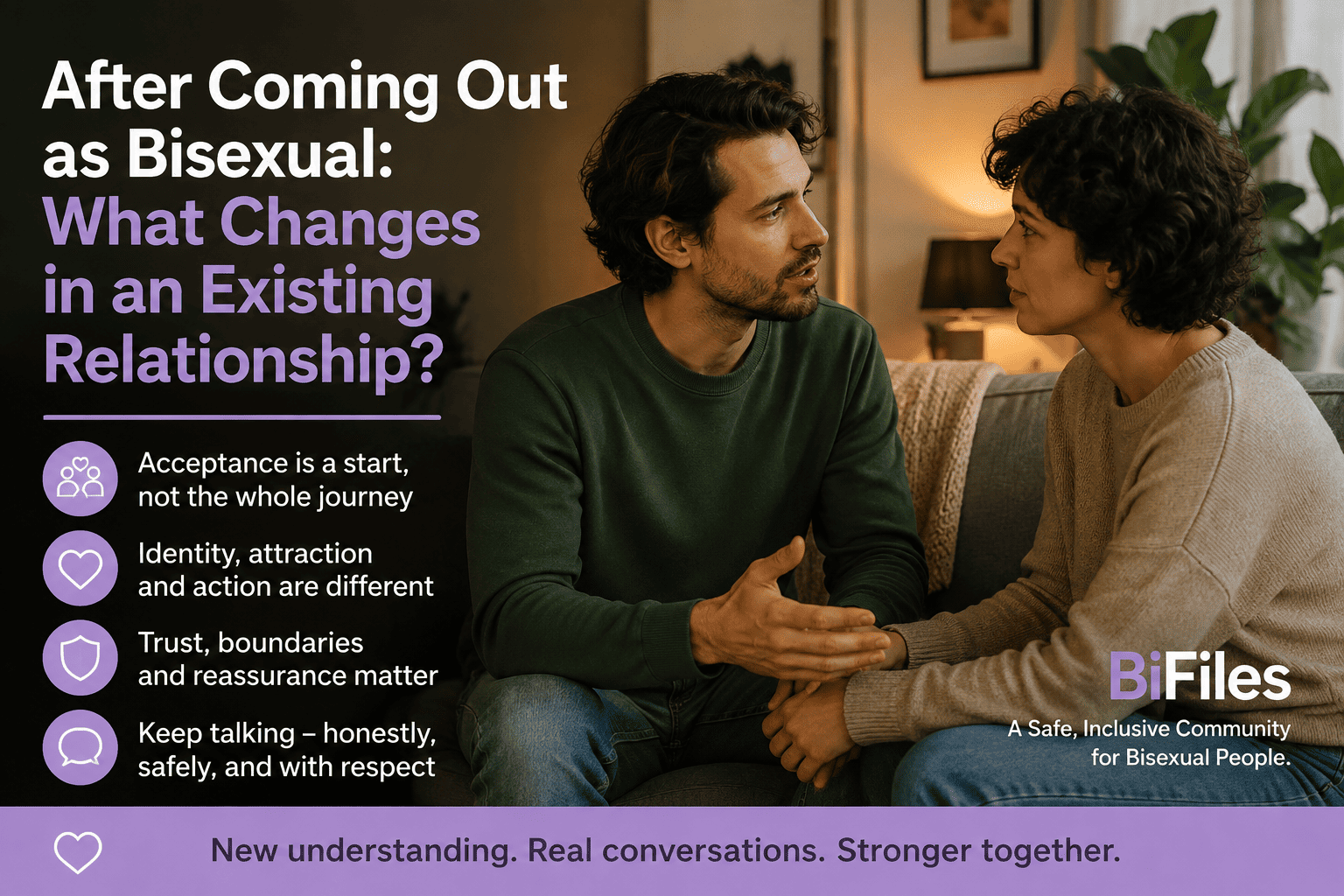
Coming out as bisexual to a long-term partner can feel like the biggest conversation. But for many couples, the first conversation is only the beginning.
A partner may respond with love and acceptance and still have questions weeks or months later. The bisexual partner may feel relieved to finally be honest, while also discovering that they do not yet know exactly what being more open about their bisexuality will mean in everyday life.
That does not automatically mean the relationship is in trouble. It often means two people are adjusting to information that may change how they understand identity, attraction, privacy, community and parts of their shared history.
Acceptance and adjustment are not the same thing
A partner can fully believe that bisexuality is real and still need time to understand what it means inside their own relationship.
At first, “I’m bisexual” may feel like a statement about identity. Later, it can become more concrete. Maybe a past attraction is talked about differently. Maybe bisexual representation suddenly matters more. Maybe the bisexual partner wants to feel more connected to bisexual community. Maybe they simply stop hiding an important part of themselves.
None of those things automatically means someone wants a different partner or a different relationship structure.
This distinction matters because couples can get into trouble when every expression of bisexuality is interpreted as a request for sexual or romantic change.
Separate identity, attraction, curiosity and action
One of the most useful things a couple can do is stop treating several different questions as though they are the same question.
- Identity: Is this person bisexual?
- Attraction: Do they experience attraction to people of more than one gender?
- Curiosity: Are there experiences they wonder about?
- A specific crush: Is there actually another person involved?
- Action: Does anyone want to act on an attraction or curiosity?
- Relationship agreements: Is either person asking for the relationship itself to change?
Someone can answer yes to one of these questions and no to all the others.
A bisexual person can notice someone attractive without wanting anything to happen. They can be curious about an experience without needing to pursue it. They can understand their sexuality more clearly without wanting to change a monogamous relationship.
Coming out reveals something about orientation. It does not automatically renegotiate the relationship.
Jealousy can appear even in a supportive relationship
Sometimes insecurity appears after the initial supportive reaction.
A partner may suddenly start comparing themselves with people of another gender. They may worry that they cannot provide every kind of experience their partner could potentially enjoy. They may fear that the “pool of competition” has become larger, or wonder whether an attraction they previously would not have noticed now matters.
Feeling insecure does not automatically make someone biphobic or unsupportive.
What matters is what happens with that insecurity.
There is a major difference between saying, “I know you love me, but I’m struggling with this and could use some reassurance,” and repeatedly questioning someone’s loyalty, checking their friendships, demanding proof or treating bisexual attraction as evidence that cheating is more likely.
The goal should not be to eliminate every uncomfortable feeling immediately. It should be to create enough trust that both people can talk about those feelings without bisexuality itself becoming the accused party.
Monogamy does not have to be renegotiated just because someone is bisexual
One of the most persistent assumptions is that coming out as bisexual creates an unmet need that must eventually be acted on.
It does not.
Bisexuality describes sexual or romantic orientation. Monogamy, non-monogamy and other relationship structures describe agreements between people. They are separate questions.
If a couple was monogamous before the disclosure, they can remain monogamous afterward. The bisexual partner does not have to “try both” to validate their identity, and their partner does not need to offer exploration simply because bisexuality has been acknowledged.
At the same time, if either person genuinely wants to discuss different boundaries or relationship structures, that conversation is allowed too. It should simply be treated as a relationship decision rather than an inevitable consequence of bisexuality.
What does “living more authentically” actually mean?
This is where couples can discover that they have been imagining very different things.
For one bisexual person, living more authentically might mean attending a bisexual community event, reading bisexual books, talking openly with trusted friends or no longer allowing people to assume they are straight or gay.
For someone else, it might mean acknowledging attractions they used to dismiss, changing how they describe themselves, or simply no longer feeling that bisexuality has to stay invisible inside their own home.
For another person, exploration may genuinely matter.
The phrase itself is too vague to make assumptions from. A better question is: What would being able to live more openly as yourself actually look like?
The answer may be far less threatening than either partner imagined.
The past may suddenly look different
Coming out later in a relationship can also cause both people to revisit the past.
The bisexual partner may remember old crushes, friendships or moments of confusion differently. Their partner may wonder whether they missed signs or whether parts of the relationship meant something different than they thought.
New understanding does not automatically invalidate old experiences.
Someone can have genuinely loved their partner while also not fully understanding their own sexuality. Recognising a previously unnamed attraction does not mean the relationship was fake, and a label discovered later does not retroactively turn every close friendship into a hidden romantic relationship.
The bisexual partner may still be figuring things out too
Coming out can create an unexpected pressure to suddenly become the expert.
A partner may reasonably have questions, but the bisexual person may not yet know every answer. They may understand their orientation before they understand what role bisexuality should have in their life, how public they want to be, whether community matters to them, or how they feel about experiences they never had.
“I don’t know yet” can be an honest answer.
A healthy relationship can leave room for someone to understand themselves gradually without treating every new thought as a warning that another major disclosure is coming.
Partners need support too
Bisexual people understandably need spaces where their identity is respected. But the partner receiving a disclosure may also need somewhere safe to sort through surprise, uncertainty or fears without placing all of that emotional processing back onto the bisexual partner.
Good support for partners should not begin with the assumption that bisexuality threatens the relationship. It should help them distinguish stereotypes from actual relationship concerns.
Instead of asking, “What does bisexuality mean will happen to us?” it can be more useful to ask, “Has either of us actually asked for something in our relationship to change?”
Often, the answer is no.
A practical conversation for the weeks after coming out
You do not need to solve everything in one conversation. In fact, returning to the subject after the initial emotions have settled can be far more useful.
Some questions worth discussing are:
- Has anything about our actual relationship changed?
- What does being more open about bisexuality mean to you personally?
- Are there assumptions either of us is making about monogamy, attraction or exploration?
- What kind of reassurance feels helpful rather than controlling?
- Is there anything you want me to understand that you struggled to explain during the first conversation?
- Are there subjects we should revisit later instead of forcing an answer now?
The aim is not to produce a perfect relationship policy. It is to make sure both people are responding to what the other person actually feels and wants rather than to stereotypes about bisexuality.
When reassurance becomes unhealthy
Adjustment can take time, but bisexuality should not become a permanent reason for one partner to surrender privacy, friendships or autonomy.
Repeated accusations, monitoring messages, demanding constant proof of loyalty, discouraging bisexual friendships or community involvement, or insisting that attraction to another gender must be hidden are not sustainable forms of reassurance.
Relationship boundaries should apply fairly. If noticing an attractive person was acceptable before coming out, bisexuality alone should not automatically turn that same experience into evidence of disloyalty.
The relationship does not have to become about bisexuality
Coming out can temporarily make bisexuality feel like the subject of every conversation.
That usually does not need to last forever.
Over time, bisexuality can become one understood part of the relationship rather than a problem that constantly needs solving. The couple can still talk about attraction, community, identity or insecurity when those things actually matter without treating them as a permanent emergency.
A relationship does not become less real because one person understands their sexuality more clearly than they did before.
Sometimes the most important change after coming out is simply that there is less hiding.
What helped other couples after coming out?
Every relationship handles this period differently. BiFiles has an open forum discussion for bisexual people and partners about what actually helped after the initial coming-out conversation.
Join or read the discussion: What Helped After Your Partner Came Out as Bisexual?
You can read quietly as a guest. If you want to reply, you can share only what feels comfortable.
If you are looking for shorter answers about coming out, relationships, privacy or bisexual identity, visit the BiFiles Support & FAQ.