How to Support a Bisexual Partner Without Making Them Feel Questioned
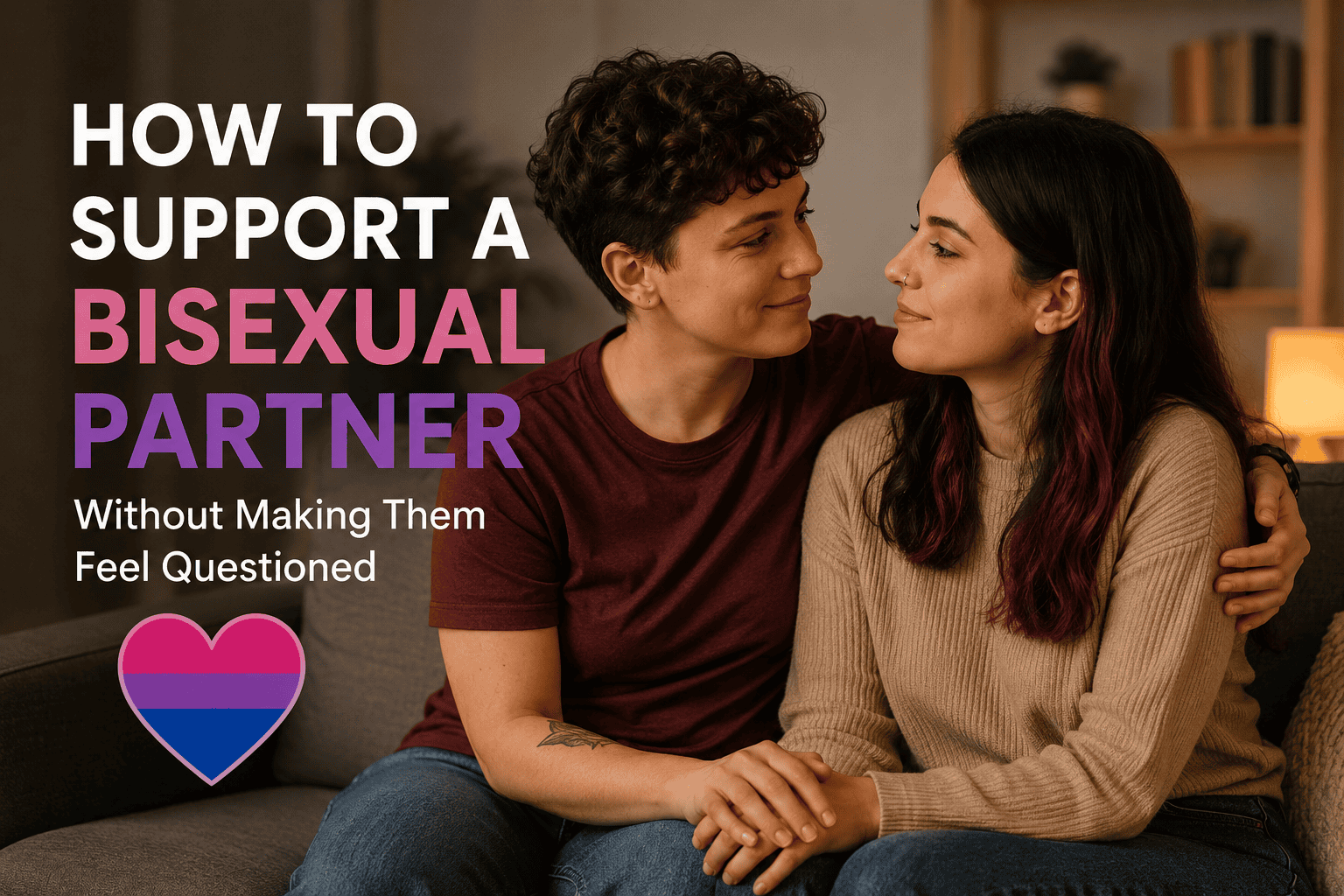
Learning how to support a bisexual partner starts with trust, respect, and a willingness to listen without treating their identity as a relationship problem.
Your partner should feel understood rather than doubted, monitored, sexualized, or pressured to prove that they are still committed to you.
If your partner tells you they are bisexual, your response may matter more than you realize. Coming out inside a relationship can feel especially vulnerable because the person is not only sharing an identity. They may also be risking the trust, security, and future they have built with someone they love.
You do not need perfect words immediately. It is reasonable to feel surprised, curious, insecure, or uncertain about what the disclosure means.
Support means handling those feelings without turning your partner’s bisexuality into an accusation, sexual fantasy, or permanent reason for suspicion.
The most important principle is simple:
Your partner’s bisexuality is not a confession of disloyalty. It is one part of who they are.
This topic connects closely with other relationship questions on BiFiles. You may also find it helpful to read My Partner Came Out as Bisexual. What Now?, Can You Be Bisexual and Monogamous?, and How to Talk to Your Partner About Being Bisexual.
How to Support a Bisexual Partner Without Questioning Them
The best way to support a bisexual partner is to believe what they tell you about themselves, listen without immediate judgment, and avoid treating bisexuality as evidence that something is wrong.
A supportive first response might be:
Thank you for trusting me. I care about you, and I want to understand what this means for you.
This response does not demand proof or assume a hidden request. It gives your partner room to explain their own experience.
You may still need time. A thoughtful response does not require instant understanding.
You can say:
I may need some time to process this, but I do not want my first feelings to become assumptions about you.
That keeps the conversation honest without making your partner regret opening up.
Believe Your Partner When They Tell You They Are Bisexual
One of the simplest forms of support is believing the identity your partner shares.
Avoid responding with:
- “Are you sure?”
- “Is this just a phase?”
- “You have only dated one gender.”
- “You are with me now, so it does not matter.”
- “You are probably actually gay.”
- “You are basically straight because of our relationship.”
Your partner may have spent years questioning, suppressing, or trying to understand their feelings before telling you.
Even when they are still uncertain, that uncertainty should not be used to dismiss them.
Someone may honestly say:
I think I am bisexual, but I am still understanding what that means.
You can respect that process without demanding a final answer immediately.
Remember That Bisexuality Is Not the Same as Cheating
One of the most damaging myths about bisexuality is that bisexual people are less loyal or more likely to cheat.
Bisexuality describes the capacity for attraction to more than one gender. Cheating involves behaviour, secrecy, and broken relationship agreements.
These are not the same thing.
A bisexual person can be:
- faithful;
- monogamous;
- deeply committed;
- satisfied in one relationship;
- honest about attraction;
- uninterested in pursuing anyone else.
People of every orientation can notice others while remaining committed. Loyalty is based on choices, values, and agreements rather than the complete absence of attraction.
Trust your partner according to their actual behaviour. Do not punish them for a stereotype before they have done anything wrong.
For more detail, read Bisexuality & Relationships: Let’s Break the Biggest Myths.
Attraction, Intentions, and Actions Are Different
Supporting a bisexual partner becomes easier when you separate attraction from intention and behaviour.
- Attraction is a feeling someone experiences.
- Intention is what they want to do with that feeling.
- Action is the behaviour they actually choose.
- Relationship agreements are the boundaries both partners have accepted.
Your partner may occasionally notice another person without wanting to pursue them. A fantasy does not automatically become a plan. A crush does not automatically become betrayal.
Monogamy generally means agreeing not to act outside the relationship. It does not require people to stop having an internal world.
Discuss actions and agreements rather than treating every possible attraction as a threat.
Do Not Make Them Prove Their Commitment Repeatedly
A bisexual partner should not have to spend the relationship repeatedly proving that you are enough.
Questions such as these can become exhausting:
- “Are you sure you are happy with me?”
- “Do you miss being with men?”
- “Do you miss being with women?”
- “Will you eventually need someone else?”
- “Which gender do you really prefer?”
- “How can I know you will not leave?”
One vulnerable conversation about insecurity may be healthy. Constantly reopening the same question can make your partner feel as though their love is permanently considered less reliable.
A more constructive question is:
Is there anything in our relationship that either of us needs to feel more secure and understood?
This focuses on the relationship rather than putting bisexuality on trial.
Ask What Bisexuality Means to Your Partner Personally
Not every bisexual person experiences attraction or identity in the same way.
For one person, bisexuality may be a central part of how they understand themselves. Another may see it as private information that does not affect daily life very much.
Your partner may experience:
- unequal attraction to different genders;
- romantic and sexual attraction in different ways;
- changing attraction over time;
- very occasional attraction beyond one gender;
- a strong need for bisexual recognition;
- little interest in public identity or community;
- certainty about being bisexual but no desire to explore.
Ask rather than assume:
What does being bisexual mean for you personally, and what would support from me look like?
Your partner is not responsible for representing every bisexual person. They only need space to explain themselves honestly.
Listen Without Turning Every Answer Back to Your Fear
You may feel insecure after hearing something unexpected. Those emotions deserve attention, but they should not take over every part of the conversation.
For example, your partner might explain that bisexuality has been important to them for years. Responding immediately with “So our whole relationship was a lie?” prevents you from hearing what they were actually trying to share.
Try listening for:
- what they understand about themselves;
- why they decided to tell you;
- what they fear losing;
- whether anything needs to change;
- what support they are asking for;
- which questions they cannot answer yet.
You can process your own feelings without requiring your partner to calm every fear during the same moment they are trying to be vulnerable.
A useful response is:
I notice that I feel insecure, but I want to understand your experience before I decide what it means for us.
Support Does Not Mean You Cannot Have Questions
Supporting your partner does not require silence or pretending that you understand everything immediately.
Respectful questions can help both of you.
You might ask:
- “How long have you been thinking about this?”
- “What made you feel ready to tell me?”
- “Does anything about our relationship need to change?”
- “Are you looking for recognition, support, or something more practical?”
- “Who else knows?”
- “How private do you want this to remain?”
- “Are there assumptions you are afraid I will make?”
The purpose of these questions should be understanding rather than evidence gathering.
An interrogation looks for contradictions and guilt. A supportive conversation looks for clarity and connection.
Avoid Treating Bisexuality as a Problem to Manage
Supporting a bisexual partner does not mean creating special restrictions because they are bisexual.
Healthy couples may discuss boundaries around flirting, dating apps, social media, private messages, friendships, and emotional intimacy. Those expectations should apply fairly to both partners.
Rules based only on bisexuality can become controlling.
Examples include:
- forbidding close friendships with several genders;
- checking their phone after they come out;
- treating all LGBTQ+ community involvement as suspicious;
- assuming every compliment is flirting;
- restricting bisexual friends;
- demanding access to private conversations;
- expecting them to avoid anyone they could theoretically find attractive.
A healthier conversation is:
Can we discuss what both of us consider respectful behaviour, regardless of gender or orientation?
Shared boundaries create trust. One-sided surveillance creates fear.
Do Not Treat Every Gender as Competition
Some partners feel that bisexuality creates “twice the competition.”
That idea assumes your partner is attracted to everyone and reduces people to interchangeable genders.
Your partner chose a relationship with you because of a specific connection. That connection includes your personality, shared history, affection, values, physical attraction, humour, intimacy, and the life you have built together.
You are not competing with every man, woman, or non-binary person in the world.
When insecurity appears, ask what the real fear is:
- Are you afraid your partner wants an experience you cannot provide?
- Do you fear being compared physically?
- Has trust already been damaged for another reason?
- Has intimacy recently declined?
- Are relationship boundaries unclear?
- Did the disclosure happen alongside another difficult revelation?
Address the specific concern instead of treating bisexuality as one large source of danger.
Do Not Assume Their Past Defines Your Future
Your partner may have previous relationships or experiences with people of different genders.
That history is not a scoreboard and does not automatically reveal what they need now.
Avoid comparing yourself endlessly with former partners or asking which gender was “better.”
People bring histories into relationships. Those histories may include affection, mistakes, growth, grief, attraction, and learning.
The important question is how your partner behaves in the relationship they have with you now.
Their past attraction to more than one gender does not weaken their present commitment.
Understand Bisexual Invisibility
Bisexual people are frequently assumed to be straight, gay, or lesbian based on the partner others can see.
A bisexual person in a different-gender relationship may be treated as straight. Someone in a same-gender relationship may be assumed gay or lesbian.
This can make bisexuality feel invisible even inside a loving relationship.
Your partner may not need you to mention their identity constantly. They may simply need you not to erase it.
Avoid comments such as:
- “You are basically straight now.”
- “You chose a side.”
- “Your bisexuality was only relevant before we met.”
- “People see us as gay, so bisexual does not matter.”
- “Our marriage proves what you really are.”
Your relationship describes one connection. It does not erase your partner’s broader orientation.
Your partner can be fully committed to you and still deserve to be recognized as bisexual.
Respect How Visible They Want to Be
Some bisexual people want their identity acknowledged openly. Others prefer privacy or selective disclosure.
Your partner may be:
- out to close friends but not family;
- open online but private at work;
- comfortable in bisexual spaces but not public social media;
- still questioning who should know;
- completely private because of safety;
- ready to become more visible over time.
Do not out your partner without permission, even when you believe your intention is supportive.
Ask:
Who knows, and who are you comfortable with me talking to about this?
They should remain in control of their own disclosure whenever possible.
You may also find Do I Have to Come Out as Bisexual? helpful.
Support Bisexual Community Without Treating It as a Threat
Your partner may want to read bisexual articles, join a forum, attend Pride, follow bi creators, or speak with people who share similar experiences.
Community involvement does not automatically mean dating, sexual exploration, or dissatisfaction with you.
It may provide:
- language for experiences they could not previously explain;
- recognition from people with similar questions;
- support around coming out or relationships;
- relief from bisexual invisibility;
- a sense of belonging;
- friendship rather than romance.
You can discuss reasonable boundaries around online and offline interaction without assuming that bisexual community is inherently dangerous.
A calm question might be:
What kind of community connection are you looking for, and how can we make sure both of us understand the boundaries?
Do Not Sexualize Their Bisexuality
Bisexuality is often turned into a fantasy, especially when bisexual women come out to male partners.
Your partner’s identity is not automatic consent to:
- a threesome;
- watching them with somebody else;
- opening the relationship;
- asking invasive questions about fantasies;
- pressuring them to gain experience;
- sharing their sexuality as entertainment;
- treating them as a route to another person.
Even apparently positive excitement can feel objectifying when it replaces emotional support.
A better response is to understand what the disclosure means before introducing sexual possibilities.
Couples can discuss fantasies when both people genuinely want to. The conversation should not be treated as the automatic result of bisexuality.
Do Not Pressure Them to Explore or Prove Their Identity
A bisexual person does not need experience with several genders before their orientation becomes valid.
Do not tell your partner they need to “try it” before they can know. Likewise, avoid encouraging exploration solely because it excites you or because you believe they will regret not doing it.
Your partner may:
- feel certain without experience;
- remain monogamous;
- have no desire to explore;
- feel curious but choose not to act;
- need time before understanding what they want;
- consider exploration only within a mutually agreed relationship structure.
Identity does not create an obligation to act.
What If Your Partner Wants Nothing to Change?
Many bisexual people disclose their identity because they want honesty and recognition rather than a different relationship.
Your partner may still want:
- monogamy;
- the same shared future;
- no outside sexual experiences;
- the same emotional commitment;
- greater freedom to use the word bisexual;
- access to supportive information or community;
- less pressure to hide or minimize themselves.
When nothing practical needs to change, support may mean learning how to acknowledge a fuller truth about the person you already love.
Consistency and respect can help the disclosure become a normal part of the relationship rather than a permanent crisis.
What If Your Partner Does Want Something to Change?
Sometimes identity recognition leads to a request for more openness, community, exploration, or a different relationship structure.
Supporting your partner’s bisexuality does not mean agreeing to every request.
Separate the issues clearly:
- Being bisexual is an identity.
- Wanting to discuss attraction is a communication preference.
- Seeking bisexual community is a social need.
- Wanting sexual exploration is a desire.
- Opening the relationship is a proposed agreement change.
You may respect the identity while declining non-monogamy. Your partner may also recognize that a particular need cannot be met within the current agreement.
Neither person should be pressured into an arrangement they do not genuinely want.
Consent given because someone fears losing the relationship is not a stable foundation for major change.
Talk About Boundaries Fairly
Support does not mean avoiding difficult relationship conversations.
Healthy couples benefit from clarity about:
- what monogamy means to them;
- what counts as flirting;
- private messages and social media;
- emotional intimacy with other people;
- dating apps;
- sharing crushes or attraction;
- community spaces;
- what should remain private.
Discuss behaviour instead of blaming orientation.
Rather than saying:
I am worried because you are bisexual.
Try:
I want us to be clear about what both of us consider respectful and trustworthy behaviour.
This shift keeps the conversation grounded in shared agreements.
Learn Without Making Your Partner Your Only Teacher
Your partner may be willing to answer questions, but they should not have to carry the entire responsibility for educating you.
You can learn independently by:
- reading bi-focused articles;
- learning about bisexual erasure;
- understanding common stereotypes;
- reading lived experiences from several bisexual people;
- learning the difference between orientation and relationship structure;
- using resources written for partners.
Return to the relationship with humility rather than assuming one article explains your partner perfectly.
You might say:
I have been reading about bisexual invisibility. I understand better why being recognized may matter even when our relationship is not changing.
Independent effort shows that you care enough to learn without placing the whole emotional load on them.
What to Say to Support a Bisexual Partner
Supportive language can be simple.
- “Thank you for trusting me.”
- “I believe you.”
- “This does not reduce my respect for you.”
- “I want to understand what bisexuality means for you.”
- “You do not need to prove your commitment because of your orientation.”
- “I may have questions, but I want to ask them respectfully.”
- “I will not tell other people without your permission.”
- “Does anything about our relationship need to change?”
- “How can I make this relationship feel safe for both of us?”
The exact wording matters less than the attitude behind it.
Your partner needs to know that honesty will not automatically lead to punishment, disbelief, or objectification.
What Not to Say to a Bisexual Partner
Certain responses can turn a vulnerable disclosure into a defensive argument.
Try to avoid:
- “Is this just a phase?”
- “Are you going to cheat?”
- “Does this mean you want an open relationship?”
- “Am I not enough?”
- “So are you really gay or straight?”
- “You need experience before you can know.”
- “Can we have a threesome?”
- “Why did you hide this from me?”
- “This changes everything.”
- “It does not matter because you are with me.”
Some of these reactions may come from real fear. That does not make them harmless.
Pause before speaking when your first response is based on panic or stereotypes.
Repairing an Unsupportive First Reaction
Not every partner responds well immediately.
You may have asked an insensitive question, become defensive, or said something based on insecurity.
A poor first reaction does not have to define every conversation that follows.
Repair begins with taking responsibility:
I realize that my first reaction made your bisexuality sound like a threat. That came from my insecurity, and I am sorry. I want to listen more carefully now.
A meaningful apology should not include excuses that place the blame back on your partner.
Follow the apology with changed behaviour:
- stop repeating stereotypes;
- respect their privacy;
- learn independently;
- ask fewer accusatory questions;
- apply boundaries fairly;
- allow the identity to exist without constant debate.
Repair becomes believable through consistency.
Express Insecurity Without Accusing Your Partner
Insecurity can occur in any relationship. Supporting your partner does not require pretending you never feel it.
The goal is to take responsibility for your emotion rather than presenting it as proof of wrongdoing.
A supportive approach is:
I know this fear is mine, and I do not want to blame you for it. Can we talk about what would help both of us feel secure?
An accusatory version is:
You are bisexual, so I cannot trust you around anyone.
The first statement invites collaboration. The second turns orientation into guilt.
For more practical guidance, read How to Build Trust With a Bisexual Partner.
Separate Bisexuality From Actual Relationship Problems
Sometimes a relationship already contains distance, jealousy, dishonesty, or unresolved conflict before bisexuality is discussed.
Do not automatically make orientation the cause of every problem.
Ask:
- Was trust already fragile?
- Have boundaries been unclear?
- Has either partner been dishonest?
- Is emotional or physical intimacy declining?
- Are we using bisexuality to avoid discussing another issue?
- Would this problem still exist if orientation were not part of the conversation?
Bisexuality should not be blamed for problems created by poor communication, incompatibility, control, or broken agreements.
What If There Has Been Actual Cheating or Dishonesty?
Occasionally, a partner comes out during a wider disclosure about secret messages, infidelity, or another broken boundary.
In that situation, keep the issues separate.
Bisexuality is not the betrayal. The dishonest behaviour is the betrayal.
Your partner remains responsible for any specific agreement they broke. Orientation should not be used as an excuse.
At the same time, accountability does not justify attacking or denying their bisexuality.
Focus on:
- what happened;
- which agreements were broken;
- whether the behaviour continues;
- what repair would require;
- whether trust can realistically return;
- whether the relationship remains healthy.
Judge the real behaviour rather than using it to confirm a stereotype about all bisexual people.
When Outside Support May Help
Some couples can work through the conversation privately. Others benefit from outside support.
Useful options may include:
- an LGBTQ+ aware therapist;
- a bisexual-informed relationship counselor;
- a confidential partner-support resource;
- a trusted person who respects privacy;
- a moderated online community;
- educational material written for both partners.
Choose support that helps you communicate more clearly rather than encouraging suspicion or hostility.
Protect your partner’s privacy when asking for advice. Coming out to you does not automatically mean they consent to being discussed with friends, family, or online groups.
For a moderated discussion about what helped couples communicate after a bisexual disclosure, read or reply to What Helped After Your Partner Came Out as Bisexual? in the BiFiles Forum. Partners and bisexual people are both welcome to share respectful perspectives. You can read without an account and create a free account when you want to reply.
A Practical Checklist for Supporting a Bisexual Partner
Support can be translated into practical behaviour.
- Believe the identity your partner shares.
- Thank them for trusting you.
- Ask what bisexuality means to them personally.
- Separate attraction from action.
- Avoid stereotypes about cheating or indecision.
- Do not demand constant reassurance.
- Discuss boundaries fairly for both partners.
- Respect their privacy and coming-out choices.
- Do not sexualize or fetishize their identity.
- Support community involvement without assuming it is dating.
- Learn independently instead of making them your only teacher.
- Take responsibility for your own insecurity.
- Repair hurtful reactions honestly.
- Judge trust through behaviour rather than orientation.
- Allow more than one conversation.
You do not need to perform every item perfectly. The wider pattern should communicate trust, dignity, and mutual respect.
Support a Bisexual Partner as a Whole Person
Your partner is not only bisexual.
They are also a person with values, choices, memories, fears, hopes, preferences, and commitments. Their orientation matters, but it does not replace everything else you know about them.
When your partner has consistently shown love, honesty, loyalty, and care, let those actions matter.
Do not allow stereotypes to become louder than the relationship you are actually living in.
Supporting a bisexual partner means seeing the whole person. It means understanding that attraction to more than one gender does not make their love less sincere.
It also means creating space where honesty is safe, questions remain respectful, and commitment is judged through behaviour.
How to Support a Bisexual Partner: Final Answer
To support a bisexual partner, believe them, listen carefully, and avoid treating their identity as evidence that the relationship is unsafe.
Bisexuality is not the same as cheating, dissatisfaction, or non-monogamy. Attraction, action, and relationship agreements are separate matters.
You may have questions or insecurity. Express those feelings without accusing, controlling, sexualizing, or repeatedly demanding proof of commitment.
Respect your partner’s privacy, acknowledge their bisexual identity, and apply relationship boundaries fairly to both people.
When your partner requests a practical change, discuss that request separately from their orientation. Support does not require either person to abandon their boundaries.
Most importantly, let honesty lead to greater understanding rather than punishment.
Your partner should not have to become smaller, quieter, or less bisexual in order to feel secure in your love.
Explore More on BiFiles
These BiFiles resources can help with partner support, trust, monogamy, coming out, and relationship communication.
- My Partner Came Out as Bisexual. What Now?
- Can You Be Bisexual and Monogamous?
- How to Build Trust With a Bisexual Partner
- How to Talk to Your Partner About Being Bisexual
- Bisexuality & Relationships: Let’s Break the Biggest Myths
- Do I Have to Come Out as Bisexual?
You can also explore the wider BiFiles Network at your own pace:
- Visit BiFiles Support & FAQ
- Read More BiFiles Articles
- Browse Community Stories
- Visit the BiFiles Forum
- Open BiFiles Chat
For broader information outside BiFiles, the Bisexual Resource Center FAQ also answers common questions about bisexuality and relationships.