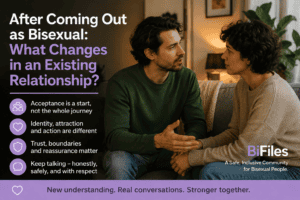
My Partner Came Out as Bisexual. What Now?

If your partner came out as bisexual, you may feel several emotions at once. You might feel trusted, confused, afraid, curious, hurt, relieved, insecure, or unsure what you are supposed to say next.
Your first reaction does not have to be perfect. The way you respond still matters. A calm response can help your partner feel safe, while an accusing or dismissive reaction may make them regret being honest.
Your partner coming out as bisexual does not automatically mean your relationship is broken. It does not prove they want somebody else, cannot remain faithful, or have stopped loving you.
In many cases, coming out means: “This is part of who I am, and I trust you enough to let you see it.”
The next step is not panic. It is understanding what the disclosure means for your partner and for your specific relationship.
You may also find it helpful to read Can You Be Bisexual and Monogamous?, Bisexuality & Relationships: Let’s Break the Biggest Myths, and How to Build Trust with a Bisexual Partner.
Your Partner Came Out as Bisexual: Take a Breath First
When someone you love says, “I’m bisexual,” your mind may immediately jump to frightening conclusions.
- Are they going to leave?
- Do they want someone of another gender?
- Were they hiding something from me?
- Am I still enough?
- Does this change our marriage or relationship?
- Were they ever genuinely attracted to me?
These fears can feel intense, especially when the conversation was unexpected. Fear, however, is not the same as evidence.
Before responding from panic, separate what your partner actually said from what you imagine the disclosure might mean.
Your partner shared an identity. They did not automatically announce a plan to leave, cheat, or change the relationship.
You do not need to solve everything during the first conversation. Listening, asking for time, and returning to the subject calmly can be much healthier than demanding immediate answers.
What Does It Mean When Your Partner Comes Out as Bisexual?
Bisexuality generally means having the capacity to experience attraction to more than one gender. That attraction may be romantic, emotional, physical, sexual, or a combination of these.
It does not tell you automatically:
- whether your partner wants another relationship;
- whether they prefer one gender over another;
- whether they want monogamy;
- whether they have acted on every attraction;
- whether your relationship needs to change;
- whether they have been unfaithful.
The word bisexual describes orientation. It does not provide a complete explanation of somebody’s intentions, values, boundaries, or relationship needs.
Those details need to come from an honest conversation with your partner rather than from stereotypes.
Your Partner Coming Out as Bisexual Does Not Mean They Love You Less
Bisexual people are capable of deep love, commitment, loyalty, and long-term partnership.
Your partner’s orientation does not automatically mean you are missing something or cannot satisfy them. It does not prove they secretly want to replace you with someone of another gender.
A person can love one partner while still having a broader capacity for attraction. Straight, gay, and lesbian people may also notice others without wanting to leave their relationships.
For many bisexual people, coming out is not about ending the relationship. It is about being seen more honestly within the relationship they already value.
Your partner may be asking to be known more fully, not asking to be loved less securely.
Bisexuality Is Not the Same as Cheating
One of the most damaging bisexual stereotypes is that attraction to more than one gender makes someone more likely to cheat.
Cheating involves behaviour, secrecy, choices, and broken agreements. Bisexuality describes attraction. These are not the same thing.
A bisexual person can be faithful. They can choose monogamy, respect boundaries, and build a lifelong relationship with one partner.
People of every orientation can behave honestly or dishonestly. Trustworthiness is shown through character and conduct, not through the number of genders someone may find attractive.
The useful question is not:
Can bisexual people commit?
A better question is:
What agreements have we made, and do both of us respect them?
Attraction, Intention, and Behaviour Are Different
Understanding three separate concepts can reduce unnecessary fear.
- Attraction: noticing romantic, emotional, or sexual interest.
- Intention: what someone wants to do with that feeling.
- Behaviour: the actions they actually choose.
Your partner may experience attraction without intending to pursue it. A passing feeling, fantasy, or crush does not automatically become a plan.
Monogamy does not require a person to stop noticing everybody else. It requires both partners to respect the relationship agreement they have chosen.
Separating attraction from action can help you discuss real boundaries instead of treating every possible feeling as a betrayal.
It Is Okay to Have Feelings Without Turning Them Into Accusations
You are allowed to feel surprised, unsettled, or insecure. Needing time does not automatically make you unsupportive or biphobic.
The way those emotions are expressed matters.
There is a difference between saying:
I need some time to understand what this means.
and saying:
So you are going to cheat on me.
Likewise, asking what the disclosure means for your relationship is different from demanding that your partner prove they are still trustworthy.
Your emotions deserve space. Your partner’s dignity deserves protection too.
Helpful Questions to Ask Your Bisexual Partner
A calm conversation can help both of you understand what this disclosure means in your particular relationship.
Helpful questions include:
- What does bisexuality mean for you personally?
- How long have you known or wondered about this?
- What made you feel ready to tell me now?
- Are you looking for acknowledgment, support, honesty, or change?
- Does this affect what you want from our relationship?
- Are there assumptions you are worried I might make?
- How can I support you without making you feel interrogated?
- What would help both of us feel secure?
- Who else knows, and who are you comfortable telling?
Your partner may not have complete answers yet. Coming out sometimes happens while someone is still learning how to describe their own experience.
Honest uncertainty is not necessarily dishonesty.
Questions to Avoid Asking in Panic
Some questions may come from fear but still land as accusatory, sexualizing, or dismissive.
Try to avoid reacting with:
- “So are you actually gay?”
- “Does this mean I am not enough?”
- “Are you going to cheat?”
- “Were you lying throughout our whole relationship?”
- “Which gender do you really prefer?”
- “Can I watch?”
- “Does this mean we need a threesome?”
- “Why tell me when you are already with me?”
These questions can reduce bisexuality to suspicion, confusion, or sexual entertainment.
When reassurance is what you need, ask for it directly:
I am feeling insecure and would like to understand whether anything about our relationship has changed for you.
What If You Feel Jealous or Insecure?
Jealousy can appear in any relationship. Bisexuality may make it feel larger because your mind imagines competition from several genders instead of one.
Your partner is not automatically attracted to every person they meet. Bisexual attraction remains selective, just like other forms of attraction.
Instead of asking your partner to minimize or deny their identity, identify the need beneath the jealousy.
- Do you need reassurance about commitment?
- Have existing trust problems returned?
- Are relationship boundaries unclear?
- Do you fear being compared with another gender?
- Has emotional or physical intimacy recently declined?
- Are you afraid your partner wants an experience you cannot provide?
Once the real fear is named, both of you can address the actual relationship rather than fighting an imagined category of competitors.
You Are Not Competing With an Entire Gender
A common fear is that a partner of another gender can offer something you never could.
This way of thinking turns people into interchangeable representatives of their gender. Your relationship is more specific than that.
Your partner chose you because of your personality, history, emotional connection, values, body, humour, care, and the life you share.
Another person is not automatically “more complete” merely because their gender is different from yours.
Comparing yourself with an imagined man, woman, or non-binary person usually creates anxiety without revealing what your partner actually wants.
What If Your Partner Wants Nothing to Change?
Many bisexual people come out because they want honesty and recognition, not because they want a different relationship.
Your partner may still want:
- monogamy;
- the same shared future;
- the same emotional and sexual commitment;
- no outside dating or sexual experiences;
- greater freedom to name their identity;
- access to bisexual community or resources.
In that situation, your role may not be to solve a relationship crisis. It may be to learn how to hold a fuller truth about the person you already love.
Acknowledging their bisexuality may involve using the correct label, avoiding jokes or stereotypes, and not describing them as straight or gay based only on your relationship.
What If Your Partner Wants Something to Change?
Sometimes coming out leads to larger conversations.
Your partner may want:
- more openness about their identity;
- connection with bisexual community;
- different language within the relationship;
- space to discuss attraction honestly;
- sexual exploration;
- a change to the relationship structure;
- time to reconsider what they want.
You do not have to agree immediately. Supporting a bisexual partner does not require abandoning your own needs, values, or boundaries.
Ask for precise language. Wanting community is different from requesting another partner. Discussing attraction is different from opening the relationship. Recognizing bisexuality is different from deciding to leave.
Each request deserves its own conversation.
Bisexuality Does Not Automatically Mean Non-Monogamy
Bisexuality, monogamy, and polyamory describe different things.
- Bisexuality describes orientation.
- Monogamy describes a relationship agreement based on exclusivity.
- Polyamory describes consensual relationships that may include more than one romantic partner.
A bisexual person may prefer monogamy or non-monogamy. The same is true for straight, gay, lesbian, pansexual, and queer people.
Do not assume that coming out is a hidden request to open the relationship.
When your partner does make such a request, consent must be genuine. Agreeing because you fear losing them is not a stable foundation for non-monogamy.
Do Not Sexualize Your Partner’s Coming-Out Moment
Some bisexual people, especially bisexual women, find that coming out is immediately turned into a conversation about threesomes, pornography, or another person’s fantasy.
This can make a vulnerable disclosure feel objectifying.
Your partner’s bisexuality is not automatic consent to:
- a threesome;
- watching them with somebody else;
- opening the relationship;
- asking invasive questions about their fantasies;
- sharing their identity as entertainment;
- pressuring them to “prove” bisexuality through experience.
Sexual possibilities can be discussed when both partners genuinely want that conversation. They should not replace the respect and emotional safety the coming-out moment requires.
Do Not Make Your Partner Prove They Are Still Yours
After coming out, bisexual people may feel pressured to reassure their partner repeatedly that they are not leaving, cheating, confused, or secretly gay.
Reassurance can be healthy. Endless interrogation is different.
Warning signs include:
- checking their phone because they are bisexual;
- restricting friendships with several genders;
- treating every social interaction as a threat;
- demanding frequent proof of attraction to you;
- requiring them to hide or deny their identity;
- using bisexuality during unrelated arguments;
- assuming every mood change means they want someone else.
Trust cannot be built by forcing one partner to remain permanently on trial.
What If Your Partner Knew for a Long Time?
You may feel hurt when your partner explains that they have known or wondered about bisexuality for months or years.
It is understandable to ask why they did not tell you earlier. Before deciding that the delay proves deception, try to understand the reasons.
They may have:
- feared rejection;
- lacked confidence in the label;
- believed it was irrelevant within a monogamous relationship;
- felt ashamed because of stereotypes;
- needed time to understand themselves;
- worried that you would assume they wanted someone else;
- previously tried to suppress or dismiss the attraction.
Understanding the reason does not mean you must ignore your feelings. You can acknowledge both truths: your partner may have been frightened, and the delay may still affect your sense of closeness.
The important question becomes whether you can talk honestly now and rebuild any trust that was affected.
What If There Was Actual Dishonesty or Cheating?
Sometimes a coming-out conversation happens alongside a real disclosure of cheating, secret messages, or broken boundaries.
In that situation, keep the issues separate.
Bisexuality is not the betrayal. The dishonest behaviour is the betrayal.
Your partner should take responsibility for specific actions without using bisexuality as an excuse. Likewise, accountability should not become permission to attack or erase their orientation.
You may need to discuss:
- which agreements were broken;
- whether contact with another person continues;
- what honest repair would require;
- whether trust can realistically be rebuilt;
- whether individual or couples counseling would help;
- whether the relationship remains emotionally safe.
Judge the behaviour fairly. Do not turn one person’s actions into a belief that all bisexual people are untrustworthy.
Respect Your Partner’s Privacy
Your partner coming out to you does not automatically mean they are ready for everyone else to know.
Do not share the information with friends, relatives, colleagues, or online communities without permission.
That includes seeking advice in a way that makes your partner identifiable.
Ask directly:
Who knows, and who are you comfortable with me talking to about this?
Being outed can affect family relationships, work, housing, safety, and emotional well-being. Even when you need support, your partner’s privacy still matters.
How to Support a Partner Who Came Out as Bisexual
Support does not require perfect words or instant understanding. It begins with respect, curiosity, and a willingness to avoid assumptions.
You can say:
- “Thank you for trusting me.”
- “I may need time to understand, but I want to listen.”
- “I do not want to make assumptions about what this means.”
- “Can you tell me what support would feel helpful?”
- “Does anything about our relationship need to change for you?”
- “I care about you, and I want us to approach this honestly.”
- “I will not tell other people without your permission.”
Practical support may include:
- using the word bisexual when that is your partner’s label;
- learning from reliable bisexual resources;
- avoiding jokes about cheating or indecision;
- not describing the relationship as proof that they are straight or gay;
- making room for bisexual community or identity expression;
- discussing boundaries without treating bisexuality as the danger.
For a deeper guide, read How to Support a Bisexual Partner Without Making Them Feel Questioned.
What If You Need Support Too?
You can support your partner and still need support for yourself.
The disclosure may challenge assumptions you held about your relationship. You may need time to process insecurity, grief, confusion, or fears about the future.
Choose support that helps you think clearly rather than feeding suspicion.
Helpful support may come from:
- a trusted person who understands confidentiality;
- an LGBTQ+ aware therapist;
- a relationship counselor familiar with bisexuality;
- educational resources written for partners;
- a moderated support community.
Be cautious with advice that immediately tells you your partner will cheat, is secretly gay, or must be pressured to choose.
Want to hear what helped other couples after this conversation? Read or reply to What Helped After Your Partner Came Out as Bisexual? in the BiFiles Forum. Partners and bisexual people are both welcome to share what supported trust, communication, privacy, or reassurance. You can read without an account and create a free account when you want to reply.
What About Children, Family, and Other People?
When you share children, a home, finances, or extended family, the conversation may feel larger than the two of you.
Coming out as bisexual does not automatically require a family announcement. You and your partner can decide together who needs to know and when.
Children generally need age-appropriate honesty, stability, and freedom from being placed in the middle of adult conflict.
Your partner’s orientation is not inherently harmful to children or family life. Hostility, secrecy, manipulation, and unresolved conflict can create harm, but bisexuality itself does not.
Avoid using children, housing, or finances to punish your partner for coming out.
When Couples Counseling May Help
Professional support may help when both partners want the relationship to remain healthy but conversations repeatedly become defensive or painful.
Counseling may be useful when:
- trust was already fragile;
- one partner feels chronically interrogated;
- the other partner cannot calm intense insecurity;
- relationship agreements may need clarification;
- coming out is connected with actual dishonesty;
- sexual or emotional needs are difficult to discuss;
- the future of the relationship feels uncertain.
Look for someone who understands bisexuality and does not automatically blame orientation for every relationship problem.
Couples counseling is not appropriate as a way to pressure somebody into suppressing their identity or accepting a relationship structure they do not want.
Signs Your Reaction Is Becoming Harmful
Processing difficult feelings takes time. Certain behaviours still need to stop before they damage the relationship further.
Your reaction may be becoming harmful when you:
- repeatedly accuse your partner without evidence;
- use bisexuality as an insult;
- monitor their devices or friendships;
- threaten to expose them;
- demand sexual access or experimentation;
- tell them to identify as straight or gay instead;
- bring up their orientation during every disagreement;
- treat reassurance as something they can never provide enough of.
Fear deserves compassion, but it cannot become permission for punishment or control.
Your Relationship Can Become More Honest From Here
Your partner coming out as bisexual may initially feel disruptive. It can also create an opening for greater honesty, tenderness, and understanding.
Neither partner needs to have every answer immediately. Some conversations will need to happen more than once.
A constructive direction includes:
- listening without assuming;
- clarifying what has and has not changed;
- respecting privacy;
- addressing real insecurity without stereotyping;
- setting mutual boundaries;
- judging trust through behaviour;
- allowing bisexuality to exist without treating it as a permanent threat.
Greater honesty does not guarantee that every relationship will remain the same. It does give both people a fairer foundation for deciding what comes next.
My Partner Came Out as Bisexual: Final Answer
If your partner came out as bisexual, the disclosure does not automatically mean they love you less, want to leave, or cannot remain faithful.
Bisexuality describes a capacity for attraction. Their intentions, behaviour, commitments, and relationship needs must be understood through conversation.
You are allowed to need time. Questions and insecurity can be discussed without turning your partner’s identity into an accusation.
Supporting them does not require abandoning your own boundaries. Likewise, protecting your needs does not require denying or punishing their bisexuality.
Your partner is still the person you knew. What changed is that they trusted you with more of themselves.
The healthiest next step is to learn what this means for the two people actually inside the relationship rather than allowing stereotypes to decide for you.
Where to Go Next on BiFiles
These BiFiles resources can help you understand bisexuality, commitment, trust, and partner support more clearly.
- Can You Be Bisexual and Monogamous?
- Bisexuality & Relationships: Let’s Break the Biggest Myths
- How to Support a Bisexual Partner Without Making Them Feel Questioned
- How to Build Trust with a Bisexual Partner
- How to Talk to Your Partner About Being Bisexual
- Do I Have to Come Out as Bisexual?
You can also explore the wider BiFiles Network at your own pace:
- Visit BiFiles Support & FAQ
- Read More BiFiles Articles
- Browse Community Stories
- Visit the BiFiles Forum
- Open BiFiles Chat
For broader bi+ information outside BiFiles, visit the Bisexual Resource Center resources.