Why Bisexual People Can Feel Lonely in LGBTQ+ Spaces
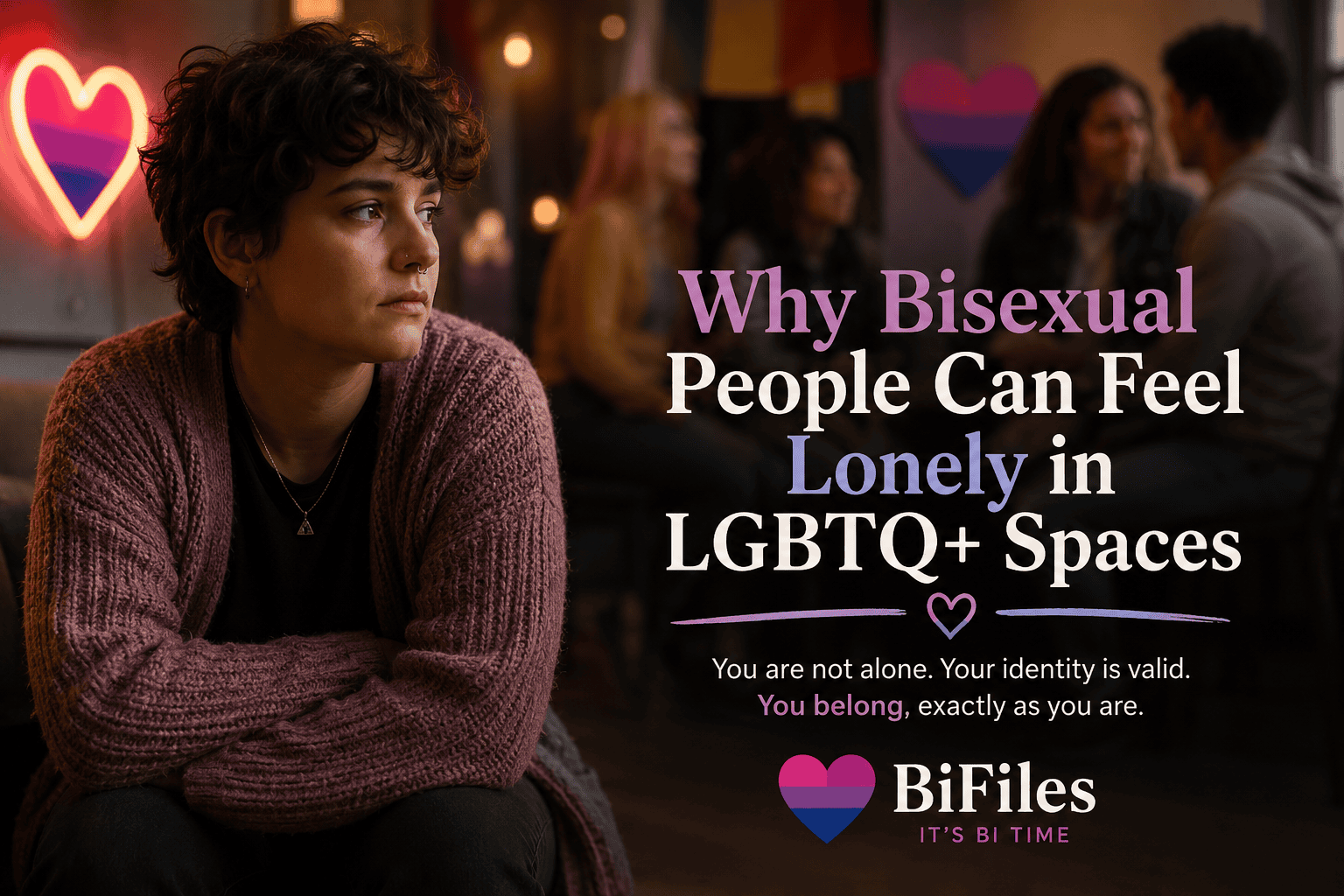
Bisexual people can feel lonely in LGBTQ+ spaces, even when those spaces are intended to offer safety, connection, and belonging. The loneliness may come from open biphobia, but it is often more subtle: assumptions, missing representation, relationship-based erasure, jokes, gatekeeping, or the feeling that bisexual experiences are welcomed in theory but rarely understood in practice.
You may enter an LGBTQ+ space hoping that you will no longer need to explain yourself. Instead, you might be treated as straight because of your current partner, assumed gay or lesbian in a same-gender relationship, or questioned because your dating history does not look “queer enough.”
That can hurt more than misunderstanding in a general social environment. The rejection or invisibility is happening inside a community where you expected recognition.
Feeling lonely in LGBTQ+ spaces does not mean you are too sensitive, difficult, or undeserving of community. It may mean that the space includes bisexual people in its language without fully including bisexual lives in its culture.
This guide explores bisexual loneliness, invisibility, relationship assumptions, gatekeeping, mental health, intersectional experiences, online community, moderation, and practical ways to find spaces where belonging does not require self-erasure.
For a broader look at bisexual support and connection, visit the BiFiles online community overview or read How to Find a Supportive Bisexual Community Online.
Being invited into a space is not the same as feeling recognized once you arrive.
Why Bisexual People Can Feel Lonely in LGBTQ+ Spaces: The Direct Answer
Bisexual people can feel lonely in LGBTQ+ spaces when their identity is:
- assumed from the gender of a current partner;
- treated as a temporary stage;
- associated with confusion, cheating, or indecision;
- included in the acronym but missing from discussions;
- questioned because of limited same-gender experience;
- dismissed because someone appears straight;
- sexualized instead of understood;
- treated as less queer or less politically committed;
- expected to fit gay, lesbian, or straight relationship narratives.
Not every LGBTQ+ space behaves this way. Many communities actively welcome and support bisexual people.
The problem is that formal inclusion does not automatically remove deeper assumptions about how sexuality is supposed to look.
Being Welcome Is Not Always the Same as Belonging
A community may state that bisexual people are welcome while its everyday culture tells a more complicated story.
You may technically be allowed to join but still notice that:
- almost every relationship discussion assumes members are gay or lesbian;
- different-gender partners are treated with suspicion;
- bisexuality appears mainly in jokes or debates;
- bi-specific concerns are redirected into more general topics;
- members repeatedly ask bisexual people to justify their labels;
- moderators ignore subtle biphobia;
- bisexual people become visible only when stereotypes are discussed.
Belonging means more than receiving permission to enter. It means being able to participate without constantly translating, defending, or minimizing your life.
Inclusion is not complete when people are present but still feel pressure to disappear.
Bisexual Invisibility Can Happen Anywhere
Bisexuality is often difficult for other people to recognize because relationships are more visible than orientation.
When a bisexual person dates someone of a different gender, they may be assumed straight. In a same-gender relationship, they may be read as gay or lesbian.
The relationship becomes the entire explanation of the person.
That pattern may create repeated decisions:
- Should I correct this person?
- Will they believe me?
- Do I have enough energy to explain again?
- Will mentioning bisexuality make my partner feel erased?
- Could disclosure make the space less safe?
- Does staying quiet mean I am erasing myself?
There is no obligation to correct every assumption. Constantly having to make the decision can still become exhausting.
Different-Gender Relationships Can Create a Specific Kind of Isolation
Bisexual people in different-gender relationships may be treated as outsiders in LGBTQ+ environments.
Others may assume they are:
- straight allies;
- visitors rather than community members;
- benefiting from a heterosexual life while claiming queer identity;
- no longer affected by biphobia;
- less committed to LGBTQ+ community;
- using bisexuality only when it is socially convenient.
A different-gender relationship can provide situational safety or social acceptance. It does not automatically remove identity-related stress, family rejection, stereotypes, or the need for queer community.
Someone may be perceived as straight while privately dealing with:
- a partner who does not understand bisexuality;
- relatives who would reject them if they knew;
- fear of coming out;
- grief about invisibility;
- internalized biphobia;
- exclusion from spaces where they hoped to belong.
A relationship that looks straight from the outside can still include a bisexual or queer person.
Same-Gender Relationships Can Also Erase Bisexuality
A bisexual person in a same-gender relationship may receive recognition as LGBTQ+ while losing recognition as bisexual.
People may assume that bisexuality was:
- a stage before coming out as gay or lesbian;
- a safer label used temporarily;
- something no longer relevant;
- proof that the person had not previously understood themselves;
- less accurate than the identity others now assign.
Being accepted under the wrong assumption can feel complicated.
Correcting the assumption may lead to questions about commitment, attraction to other genders, or why bisexuality still matters inside the relationship.
The bisexual person may therefore remain quiet to avoid disrupting a sense of acceptance that feels conditional.
Your relationship can make one part of your identity more visible while making another part disappear.
Single and Inexperienced Bisexual People Can Feel Excluded Too
Relationship-based erasure is not limited to partnered people.
A bisexual person who is single or has dated only one gender may fear that their identity lacks evidence.
They may wonder:
- Do I belong without same-gender experience?
- Will people think I am only curious?
- Am I taking space from people with more visible queer lives?
- Do fantasies and attraction count without dating?
- Will others treat me as straight until I prove otherwise?
Experience can help someone understand preferences. It is not a membership requirement for bisexuality or LGBTQ+ community.
Read Feeling “Not Bi Enough”? Why So Many Bisexual People Struggle With This when lack of experience becomes a source of self-doubt.
The Feeling of Being “Not Queer Enough”
Many bisexual people worry that they are not sufficiently queer to participate.
This fear may be stronger when someone:
- is in a different-gender relationship;
- is not publicly out;
- has limited LGBTQ+ community experience;
- does not attend Pride or queer events;
- has mostly dated one gender;
- discovered bisexuality later in life;
- appears gender-conforming;
- prefers monogamy;
- does not use queer cultural language confidently.
The person may begin observing rather than participating. They might avoid discussing relationships, remove their partner from stories, or introduce themselves cautiously to prevent judgment.
Over time, that self-monitoring can make community feel like another place where authenticity must be managed.
You do not need to present a particular relationship history, appearance, or level of public visibility before bisexual community becomes relevant to you.
Biphobia Can Exist Inside LGBTQ+ Communities
LGBTQ+ people can experience discrimination and still absorb stereotypes about other identities.
Biphobic messages inside queer spaces may include:
- “Bisexuality is only a transition.”
- “Bi people eventually choose.”
- “You can leave the community whenever it becomes inconvenient.”
- “Bisexual partners are less trustworthy.”
- “People in different-gender relationships should not take up queer space.”
- “Bi men are actually gay.”
- “Bi women are performing for male attention.”
- “Bisexuality is less serious than other orientations.”
These messages may appear as jokes, dating preferences, political arguments, assumptions, or direct exclusion.
Not every disagreement involving a bisexual person is biphobia. A repeated pattern of treating bisexuality as less real, less stable, or less deserving of community is different from an ordinary interpersonal conflict.
Stereotypes Can Make Honest Conversation Feel Unsafe
Bisexual people are frequently associated with confusion, indecision, promiscuity, cheating, and inability to commit.
When those stereotypes are common in a space, members may avoid discussing:
- attraction to several genders;
- changes in attraction over time;
- crushes within a monogamous relationship;
- different-gender partners;
- questions about labels;
- limited relationship experience;
- fears about coming out;
- relationship structures;
- mental health and loneliness.
A person may worry that an ordinary relationship difficulty will be blamed on bisexuality.
They may therefore show only the parts of their life least likely to confirm a stereotype. That silence can increase isolation even while they remain socially present.
Sexualization Can Replace Support
Some bisexual people enter LGBTQ+ spaces looking for friendship, understanding, or identity support and are immediately treated as dating prospects or sexual opportunities.
This can happen through:
- unsolicited private messages;
- questions about threesomes;
- assumptions that bisexuality means sexual availability;
- couples seeking a third person;
- invasive questions about bodies and sexual history;
- flirting inside spaces clearly intended for support;
- pressure to explore before someone feels ready.
Dating and sexual communities can be valuable when their purpose is clear. Problems arise when every bisexual space is treated as a dating pool.
People need environments where identity can be discussed without being sexualized.
Discussions About “Straight Privilege” Can Become Oversimplified
A bisexual person in a different-gender relationship may experience situational advantages because the relationship is perceived as straight.
They may avoid certain forms of public harassment or legal discrimination that visibly same-gender couples face.
Acknowledging that reality is important. It does not mean the bisexual person has stopped experiencing:
- biphobia;
- identity erasure;
- fear of disclosure;
- family rejection;
- mental health pressure;
- relationship stereotypes;
- exclusion from community;
- the need for LGBTQ+ support.
Privilege can depend on context. Erasure may produce safety in one moment and loneliness in another.
A productive discussion can recognize situational privilege without treating bisexual identity as fictional or community membership as fraudulent.
Bisexual Experiences Are Sometimes Treated as Secondary
Many LGBTQ+ organizations developed through histories of gay, lesbian, trans, queer, and broader activism. Those histories deserve recognition.
Bisexual people may still notice that discussions are structured around monosexual experiences.
For example:
- coming out is described as moving from straight to gay;
- relationships are discussed as either heterosexual or homosexual;
- visibility assumes one stable direction of attraction;
- same-gender experience becomes the main measure of queerness;
- bisexual erasure receives little dedicated attention;
- resources rarely address mixed-orientation assumptions.
A bisexual person may relate to parts of these discussions while still feeling that their central experience is missing.
Being included under a broad umbrella does not remove the need for bi-specific language and resources.
Coming Out Can Happen Repeatedly
Bisexual people may need to come out repeatedly because other people keep assigning them a different orientation.
A new partner, workplace, social group, or community can restart the process.
Inside LGBTQ+ spaces, coming out may involve explaining:
- why a previous gay or lesbian label changed;
- why a different-gender relationship did not make them straight;
- why same-gender dating did not make them gay or lesbian;
- why bisexuality remains relevant during monogamy;
- why limited experience does not invalidate attraction;
- why privacy does not equal shame.
Repeated disclosure can make belonging feel conditional on continuous explanation.
Read Coming Out Twice: When Your Sexuality Label Changes for more about changing labels and repeated disclosure.
Online LGBTQ+ Spaces Can Intensify Gatekeeping
Online communities can provide access to support that is unavailable locally. They can also reward conflict, certainty, and short judgments.
Bisexual people may encounter:
- arguments over definitions;
- pressure to choose the most precise label;
- public criticism based on limited context;
- identity-ranking and gatekeeping;
- hostility toward different-gender partners;
- sexualized private messages;
- claims that doubt proves someone is not bisexual;
- moderators who treat biphobia as harmless debate.
Large platforms may make these conflicts appear representative of all LGBTQ+ community. They are not.
A loud or hostile group is still only one environment.
Good online spaces create room for uncertainty, nuance, privacy, and disagreement without allowing identity invalidation to become entertainment.
Self-Silencing Can Make Loneliness Worse
After repeated invalidation, a bisexual person may begin editing themselves before anyone else has the opportunity to react.
Self-silencing may involve:
- avoiding mention of a different-gender partner;
- not correcting an incorrect gay or lesbian assumption;
- hiding limited experience;
- staying silent during biphobic jokes;
- avoiding bisexual labels;
- not asking for support;
- presenting attraction as simpler than it feels;
- leaving conversations before becoming visible.
These choices may protect someone from immediate conflict. Over time, they can create the feeling that nobody actually knows them.
The solution is not always to disclose more. It may be to find at least one person or space where less editing is required.
Internalized Biphobia Can Follow You Into Community
Negative beliefs about bisexuality can become internalized before someone enters an LGBTQ+ space.
You may already believe:
- your experience is too ordinary to matter;
- other LGBTQ+ people have more right to speak;
- different-gender relationships make you an outsider;
- you need same-gender experience before joining;
- changing labels makes you unreliable;
- asking for bi-specific support is selfish;
- privacy makes you less authentic.
A dismissive environment can reinforce these beliefs. A supportive one can help challenge them.
When self-doubt becomes constant, ask whether the judgment reflects your actual behaviour or a stereotype you have absorbed.
Gender Can Shape Bisexual Loneliness Differently
Bisexual people do not encounter one identical form of stigma.
Bisexual women may be sexualized, treated as experimenting, or assumed to be performing attraction for men.
Bisexual men may be relabeled as gay, treated as untrustworthy, or excluded because people assume attraction to men determines their “real” orientation.
Non-binary bisexual people may face pressure from definitions that assume only men and women exist. They may also encounter both bisexual erasure and misunderstanding of their gender.
Trans bisexual people can experience additional gatekeeping when others question whether their sexuality or gender is valid.
These patterns overlap, but they are not interchangeable. Community becomes stronger when bisexual people can describe different experiences without one group being treated as the universal model.
Race, Culture, Religion, Disability, and Age Matter Too
Bisexual loneliness may be shaped by several parts of a person’s life at once.
Someone may feel excluded because LGBTQ+ spaces do not understand:
- racial or cultural identity;
- religious background;
- disability or access needs;
- class and financial limitations;
- later-in-life discovery;
- parenthood;
- migration or language barriers;
- rural isolation;
- gender identity;
- the risks of public visibility.
An event can be affirming about sexuality while remaining inaccessible, culturally narrow, expensive, age-limited, or unwelcoming in another way.
A person should not have to choose which part of themselves is allowed into the room.
The Mental Health Impact of Community Exclusion
Feeling lonely in LGBTQ+ spaces can affect emotional wellbeing because community is often sought during vulnerable periods.
You may be questioning, coming out, experiencing family rejection, navigating a relationship, or trying to understand feelings that were hidden for years.
When community also feels unsafe, the person may experience:
- increased loneliness;
- identity self-doubt;
- anxiety about speaking;
- shame;
- withdrawal;
- loss of trust;
- emotional exhaustion;
- the belief that no community will understand.
These feelings do not mean bisexuality is a mental health problem. They may reflect repeated invalidation and unmet needs for safety and recognition.
Read Bisexual Mental Health: Why Being Bi Can Feel So Isolating for a broader discussion of erasure, stress, boundaries, and affirming support.
Loneliness Does Not Mean You Do Not Belong
When a community feels lonely, it is easy to assume the problem is personal.
You may think:
- I am too sensitive.
- I should be grateful that the space includes me at all.
- I am asking for special treatment.
- My life is too straight to count.
- I am not confident enough to participate.
- Everyone else understands community except me.
Loneliness often points toward an unmet need rather than a personal defect.
You may need:
- more bisexual representation;
- clearer moderation;
- a smaller group;
- less pressure to disclose;
- people with similar relationship experiences;
- one-to-one connection instead of large events;
- a bi-specific space;
- a community with better privacy.
Not every space will meet every need. Repeatedly feeling diminished is still a valid reason to look elsewhere.
Have you felt out of place in a community that was supposed to feel inclusive? Read or reply to Why Can Bisexual People Still Feel Out of Place in LGBTQ+ Spaces? in the BiFiles Forum. You can read without an account and create a free account when you want to reply.
What Supportive LGBTQ+ Spaces Do Differently
A supportive space does more than include bisexuality in its name.
It may:
- avoid assuming orientation from a partner;
- include bisexual topics regularly;
- challenge jokes and stereotypes;
- welcome people with limited experience;
- respect different-gender relationships;
- leave room for changing labels;
- distinguish privacy from shame;
- protect members from sexual solicitation;
- moderate identity invalidation;
- listen when bisexual members describe recurring problems.
Healthy spaces do not require every bisexual person to have the same politics, relationships, labels, or level of visibility.
They create enough structure for people to disagree without debating whether another member’s identity exists.
Signs an LGBTQ+ Space May Not Be Bi-Affirming
Pay attention when a community repeatedly:
- treats different-gender partners as evidence against queerness;
- allows bisexuality to be described as a phase;
- expects members to disclose sexual history;
- dismisses bi-specific concerns as unnecessary division;
- sexualizes bisexual members;
- allows hostile private messaging;
- frames every bisexual relationship issue as inevitable;
- requires public visibility to establish belonging;
- ignores complaints about biphobia;
- uses humiliation instead of moderation.
One awkward comment may be repairable. A continuing culture matters more than a statement of inclusion on the homepage.
Moderation Makes a Major Difference
Community rules are meaningful only when moderators apply them consistently.
Bi-aware moderation should address:
- identity invalidation;
- relationship-based erasure;
- stereotypes about cheating;
- sexualization and unwanted messages;
- gatekeeping based on dating history;
- anti-trans or non-binary exclusion;
- pressure to come out;
- personal attacks disguised as debate.
Moderators do not need to prevent every disagreement. They should distinguish discussion from repeated attempts to make another member defend their existence.
Clear categories can also help. Support conversations, dating introductions, sexual discussion, and general social chat should not automatically be mixed together.
What LGBTQ+ Allies and Community Members Can Do
Supporting bisexual members does not require expert knowledge.
Helpful actions include:
- believing the label someone uses;
- not assigning orientation from a partner;
- challenging bisexual jokes;
- including bi-specific examples;
- respecting privacy;
- avoiding invasive questions;
- not assuming monogamy or non-monogamy;
- welcoming different-gender partners respectfully;
- listening without immediately becoming defensive;
- learning independently rather than expecting one bisexual person to explain everything.
A useful response may be simple:
I understand that your current relationship does not erase your bisexuality. You belong here without needing to prove it.
Bisexual People Should Not Have to Fix Every Space
Bisexual members are often asked to educate communities that are excluding them.
Advocacy can be meaningful when someone has the energy and support. It should not become another entrance fee.
You are not required to:
- correct every stereotype;
- teach moderators how to moderate;
- share personal trauma as evidence;
- remain in hostile debates;
- represent every bisexual person;
- stay in a space because leaving feels politically disappointing;
- accept ongoing harm in the name of community unity.
Sometimes speaking up helps. At other times, leaving, blocking, or finding another environment protects your wellbeing more effectively.
Finding Bi-Focused Community Can Help
Bi-focused spaces can offer conversations that begin with shared context.
Members may be more familiar with:
- unequal or changing attraction;
- relationship-based invisibility;
- coming out more than once;
- bi imposter syndrome;
- straight-passing family life;
- limited same-gender experience;
- biphobia within LGBTQ+ environments;
- the difference between orientation and relationship structure.
A bi-focused community does not have to replace broader LGBTQ+ spaces. It can provide a layer of support that general spaces may not offer.
The strongest community network may include several kinds of connection rather than one group expected to meet every need.
Smaller Communities May Feel Safer Than Large Ones
Large groups can offer variety and activity. They may also feel impersonal, fast, or conflict-heavy.
A smaller community may provide:
- recognizable members;
- more consistent moderation;
- slower conversations;
- greater accountability;
- less pressure to perform;
- more room for nuanced stories;
- safer relationship-building over time.
Smaller does not automatically mean healthier. Observe how the group handles disagreement, privacy, new members, and vulnerable disclosures.
You Can Participate Quietly
You do not need to introduce yourself, disclose your relationship, or share a coming-out story immediately.
Quiet participation may include:
- reading articles;
- browsing older forum discussions;
- observing moderation;
- saving useful posts;
- reading community stories;
- joining without posting;
- asking one general question later;
- using an account that protects identifying details.
Reading can help you decide whether a community deserves your trust.
For more support around low-pressure participation, read I’m Not Ready to Post. Do I Still Belong?
Leaving a Harmful Space Is Not a Failure
Leaving an LGBTQ+ space can feel like losing access to community itself.
You may worry that:
- there is nowhere else to go;
- leaving proves you never belonged;
- you should stay and improve the space;
- other people have experienced worse;
- you are abandoning LGBTQ+ community;
- the problem is only your sensitivity.
One group does not own LGBTQ+ identity or determine your right to belong.
Leaving may create grief, especially when you formed friendships there. It may also create room for healthier connection.
You can leave the platform, remain connected with selected people, reduce participation, or take a temporary break.
Build a Personal Support Network Instead of Depending on One Space
No single community needs to meet every emotional, social, identity, and relationship need.
Your support network might include:
- one trusted bisexual friend;
- a broader LGBTQ+ group;
- a bi-specific online community;
- a therapist or counselor;
- a supportive partner;
- private reading and reflection;
- a hobby group where sexuality is not central;
- selected family members;
- local events attended occasionally.
Different connections can offer different forms of belonging.
A small number of reliable relationships may feel more supportive than being visible inside a large but impersonal community.
How to Care for Yourself When Community Feels Lonely
Community disappointment can be emotionally draining.
Helpful steps may include:
- naming the specific behaviour that hurt;
- taking a break from conflict-heavy spaces;
- speaking with one trusted person;
- documenting harassment when reporting is necessary;
- blocking people who repeatedly cross boundaries;
- avoiding endless debates about identity;
- looking for bi-specific resources;
- remembering that one community does not represent everyone;
- seeking professional support when loneliness affects daily life.
Self-care cannot repair a harmful community by itself. It can help protect your wellbeing while you decide what to do next.
Questions to Ask When Evaluating a Community
Before investing deeply in a group, consider:
- Are bisexual people discussed with respect?
- Do moderators respond to identity invalidation?
- Are different-gender relationships welcomed?
- Can people remain private or questioning?
- Are support and dating clearly separated?
- Does the space include bisexual topics regularly?
- Are non-binary and trans bisexual people respected?
- Can disagreement happen without humiliation?
- Do members protect confidential information?
- Do I generally feel calmer, clearer, or more connected after participating?
No community will be perfect. A healthy one should show enough willingness to listen, moderate, repair harm, and improve.
You Are Allowed to Want More From LGBTQ+ Community
Wanting bi-specific recognition does not mean rejecting broader LGBTQ+ solidarity.
You can value shared community while asking for:
- better representation;
- clearer language;
- stronger moderation;
- respect for different relationships;
- less gatekeeping;
- space for bisexual history and culture;
- recognition of bi-specific stigma;
- support that does not require proof.
Community solidarity becomes stronger when differences can be named rather than erased.
Belonging should not require you to become easier to categorize.
Why Bisexual People Can Feel Lonely in LGBTQ+ Spaces: Final Answer
Bisexual people can feel lonely in LGBTQ+ spaces when bisexuality is formally included but practically misunderstood.
Relationship assumptions may cause someone to be treated as straight, gay, or lesbian instead of bisexual. Limited experience, privacy, monogamy, later recognition, or a different-gender partner can also trigger doubts about whether the person belongs.
Biphobia may appear through stereotypes, jokes, gatekeeping, sexualization, exclusion, or the repeated demand to prove identity.
These experiences can lead to self-silencing, loneliness, anxiety, and the feeling that there is no space where the whole person can be visible.
Feeling lonely does not mean you lack a legitimate place in LGBTQ+ community. It may mean that the specific environment is not meeting your needs.
Look for spaces with clear moderation, respect for privacy, bi-specific language, room for different relationships, and a culture that does not turn identity into a debate.
You may participate quietly, join a smaller group, find bi-focused community, build one-to-one connections, or leave spaces that repeatedly make you feel diminished.
You deserve community where bisexuality is not merely permitted, but genuinely understood as part of the people who belong there.
Explore More on BiFiles
These BiFiles resources can help with bisexual loneliness, identity, self-doubt, mental health, coming out, relationships, and finding community.
- How to Find a Supportive Bisexual Community Online
- I’m Not Ready to Post. Do I Still Belong?
- Bisexual Mental Health: Why Being Bi Can Feel So Isolating
- Feeling “Not Bi Enough”? Why So Many Bisexual People Struggle With This
- Bisexuality Beyond Labels
- Coming Out Twice: When Your Sexuality Label Changes
- Navigating Bisexuality in a Straight-or-Gay World
- Explore the BiFiles Online Community
You can also explore the wider BiFiles Network at your own pace:
- Visit BiFiles Support & FAQ
- Read More BiFiles Articles
- Browse Community Stories
- Visit the BiFiles Forum
- Open BiFiles Chat
For broader bi+ information outside BiFiles, visit the Bisexual Resource Center FAQ.