Feeling “Not Bi Enough”? Why So Many Bisexual People Struggle With This

Feeling “not bi enough” is more common than many bisexual people realize. You may question yourself because you have mostly dated one gender, have little sexual experience, are in a relationship that looks straight from the outside, or experience attraction differently depending on gender.
Others feel not bi enough because their attraction changes over time, because they previously used another label, or because they do not feel visibly connected to LGBTQ+ culture.
These doubts can become one of the quietest but most painful parts of questioning or accepting bisexuality.
The central truth is simple: bisexuality is not something you have to earn.
You do not need a balanced dating history, a public coming-out story, Pride merchandise, sexual experience with multiple genders, or anyone else’s approval. Your relationship status and appearance do not decide whether your internal experience is real.
If you are looking for a calm place to explore these doubts, BiFiles is a bisexual online community where you can read, reflect, read or reply to forum discussions, use chatrooms, and find supportive resources without needing to prove that you are “bi enough.”
Why Do I Feel Not Bi Enough?
Bisexuality is often misunderstood, even within LGBTQ+ spaces. People still expect attraction to look neat, balanced, consistent, and easy to explain.
Real attraction rarely follows such a simple pattern.
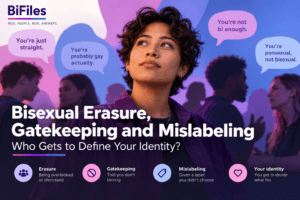
Many bisexual people grow up hearing messages such as:
- “It’s just a phase.”
- “You have to pick one.”
- “You cannot know unless you have dated both.”
- “If you marry a man, you are straight.”
- “If you date a woman, you are lesbian.”
- “Bisexual people always need more than one partner.”
- “You are only saying you are bi for attention.”
Those messages can sink in deeply, even when you consciously know they are inaccurate. Instead of asking, “What do I genuinely feel?” you may begin asking, “Do I qualify?”
That shift turns identity into a test. It encourages bisexual people to measure themselves against stereotypes instead of listening to their own experience.
You Do Not Need Equal Attraction to Be Bi Enough
One of the biggest myths about bisexuality is that attraction must be perfectly balanced.
It does not.
Some bisexual people experience attraction to different genders in different ways. Romantic feelings may develop more easily toward one gender, while physical attraction feels stronger toward another. Someone may also have a clear preference without their attraction being limited to only one gender.
Your pattern might include:
- frequent attraction toward one gender and occasional attraction toward another;
- romantic attraction that differs from sexual attraction;
- preferences that change during different periods of life;
- attraction that depends strongly on trust or emotional connection;
- different preferred traits or presentations across genders;
- rare but meaningful attraction to more than one gender.
None of these patterns makes someone less bisexual.
You do not need a 50/50 split. Bisexuality is not a math problem, and it is not a checklist of genders that must be represented equally.
For more about changing or uneven attraction, read Am I Bisexual If My Attraction Changes Over Time?
Do I Need Experience to Be Bi Enough?
No. You do not need dating or sexual experience with multiple genders to know that bisexuality may fit you.
Attraction can exist before experience. Straight people are rarely expected to date several people before they are allowed to recognize heterosexual attraction. Gay and lesbian people do not need a complete relationship history before their feelings count either.
The same principle applies to bisexual people.
You may have:
- never dated anyone;
- only dated men;
- only dated women;
- recognized same-gender attraction while already committed to a partner;
- felt attraction without wanting to pursue it;
- backed out of an experience because you were not ready.
None of this automatically invalidates your orientation.
You do not have to prove you are bisexual by doing something before you feel ready.
Exploration is optional. It may help some people learn about themselves, but it is not an entrance requirement for bisexual identity.
Relationship History Does Not Define Your Identity
A common source of feeling not bi enough is relationship history.
Maybe you have only dated men. Perhaps you have only dated women. You may be married, raising children, or in a long-term relationship that causes other people to assume your orientation.
Your history does not cancel what you feel internally.
A bisexual woman dating a man is not automatically straight. A bisexual man with a male partner is not automatically gay. Someone who has never had a relationship is not “confused by default.”
Your current relationship describes one real connection. It does not define the full range of people you may be capable of finding attractive.
Marriage does not erase bisexuality. Monogamy does not erase bisexuality. A long history with one gender does not require you to deny attraction beyond that history.
Feeling Not Bi Enough in a Straight-Looking Relationship
Bisexual people in different-gender relationships often feel especially invisible.
Other people may look at the couple and assume both partners are straight. Queer acquaintances may treat the bisexual partner as though they have left the LGBTQ+ community or chosen a less queer life.
This can create a difficult contradiction. The relationship may be loving and meaningful, while the way others interpret it makes part of your identity disappear.
You should not have to repeatedly prove that you still belong.
Your partner may change how other people read you. They do not change who you are.
A straight-looking relationship is a description of appearance, not an accurate definition of everyone inside it.
Feeling Not Bi Enough in a Same-Gender Relationship
Erasure also happens in same-gender relationships.
A bisexual man dating a man may be described as gay. A bisexual woman with a woman may be described as lesbian. People sometimes treat the current partner as proof that bisexuality was only confusion.
That interpretation is equally inaccurate.
Being with someone of the same gender does not force you to adopt a gay or lesbian label. You may use those words in specific contexts if they feel useful, but nobody else gets to replace bisexuality for you.
A relationship can be visibly queer while bisexuality remains invisible within it.
What If I Previously Used Another Label?
You may feel not bi enough because you previously identified as straight, gay, lesbian, asexual, greysexual, pansexual, or something else.
A changing label does not automatically mean you were dishonest.
Your previous label may have reflected what you understood, felt, or could safely name at that time. Later experiences, language, self-acceptance, or reflection may give you a broader understanding.
You can say:
That was the closest word I had before, but bisexual feels more accurate now.
Changing the language you use does not erase your past. It means you continued listening to yourself.
Can I Be Bisexual and Asexual or Greysexual?
Bisexuality can overlap with identities on the asexual spectrum.
Bisexuality may describe the genders toward whom attraction can occur. Asexuality or greysexuality can describe how often, how strongly, or under what circumstances sexual attraction happens.
Someone may experience sexual attraction rarely while still recognizing that it is not limited to one gender. Another person may experience romantic attraction toward multiple genders without experiencing much sexual attraction.
You may use more than one label, choose one broader label, identify as queer, or remain unlabeled.
The overlap does not make you inconsistent or less bi enough.
What If My Attraction Changes Over Time?
Changes in attraction can trigger intense self-doubt.
During a period of stronger attraction to one gender, you may wonder whether previous feelings were imagined. If your attraction shifts again, you might feel as though you have to restart the entire identity process.
You do not need to reinterpret yourself every time the intensity changes.
Some bisexual people experience a changing pattern that is sometimes called the “bi-cycle.” Others dislike that term or do not relate to it.
The important point is that attraction does not need to remain perfectly stable for your experience to be genuine.
A quieter period does not erase earlier attraction. A powerful new crush does not automatically cancel the rest of your history.
What If Bisexuality Is Only a Quiet Part of My Identity?
Bisexuality does not need to be the most visible or central part of your identity.
For some people, being bisexual strongly shapes community, relationships, politics, creativity, and everyday life. For others, it is one quiet part of themselves that rarely needs attention.
Both experiences are valid.
You do not need to attend Pride events, display flags, discuss sexuality frequently, or build your entire social identity around being bisexual.
How central bisexuality feels may also change depending on context, safety, culture, religion, disability, gender, relationship status, or life stage.
A quiet identity is still a real identity.
Queer Gatekeeping Can Make You Feel Not Bi Enough
Self-doubt does not always begin inside you. Sometimes it is produced by communities that claim to be inclusive.
Bisexual people may be treated as outsiders because they:
- are dating someone of a different gender;
- present in a conventionally feminine or masculine way;
- have limited same-gender dating experience;
- do not participate visibly in queer culture;
- previously identified as straight;
- talk positively about a straight partner;
- use bisexual instead of another label.
This can leave people feeling caught between straight and LGBTQ+ spaces.
You do not become less bisexual because another person misunderstands your relationship, presentation, history, or priorities.
A supportive queer community should not require you to perform bisexuality in one approved way.
The Pressure to Prove You Are Bi Enough
Bisexual people are often pressured to provide evidence of their orientation.
You may feel expected to disclose private crushes, sexual experiences, fantasies, or dating history so that someone else will believe you.
The demand for proof can also become internal. You might monitor every feeling and ask yourself questions such as:
- Was that attraction strong enough?
- Have I dated enough people?
- Do I seem too straight?
- Am I allowed to belong in LGBTQ+ spaces?
- What if my attraction changes again?
- Will people think I am seeking attention?
Constantly auditing your identity is exhausting.
You are allowed to keep personal experiences private. Disclosure is not a required payment for recognition.
For a focused discussion about self-doubt, experience, visibility, relationships, and belonging, read or reply to What Makes You Feel “Not Bi Enough”—and What Helps? in the BiFiles Forum. You can read without an account and create a free account when you want to reply.
Being Desired Is Not a Requirement for Bisexuality
Some people connect feeling not bi enough with fears that nobody will want them.
Age, disability, scars, weight, body changes, mental health history, or limited relationship experience may affect confidence. They can make someone believe that sexuality only matters if another person finds them desirable.
That is not how orientation works.
Your bisexuality is not measured by how many people want to date you, whether you are currently sexually active, or how closely your appearance matches conventional beauty standards.
Your orientation is not measured by whether you believe anyone will want you.
You deserve identity, dignity, community, and connection without first proving that you are desirable to someone else.
Later-in-Life Discovery Does Not Make You Less Bi Enough
Some people recognize bisexuality in adolescence. Others understand it after marriage, parenting, divorce, retirement, or decades of suppressing certain feelings.
A later realization does not make bisexuality less real.
You may have followed the relationship path that was expected of you. Perhaps inclusive language was not available, or your environment made honest exploration feel unsafe.
Later recognition can bring relief, excitement, grief, anger, and sadness about lost time. Several emotions can exist together.
You do not need to be young, newly dating, or publicly out to belong in bisexual community.
You Are Allowed to Trust Your Own Experience
Part of self-acceptance is learning to trust yourself even when other people do not fully understand.
This does not mean you must have every answer immediately. Doubt may not disappear overnight. Your internal experience still matters.
If the word bisexual helps you understand your attraction, connect with your feelings, or move through life more honestly, that matters.
Labels are not meant to trap you. They offer language for what feels true.
If your understanding later grows or changes, that is allowed too. Growth does not mean you were lying. It means you were learning.
Why Feeling Not Bi Enough Can Hurt So Much
Feeling not bi enough can affect confidence, relationships, and emotional well-being.
You may hesitate to join LGBTQ+ spaces because rejection feels possible. Fear can stop you from opening up to a partner or asking for support. Some people become isolated even while surrounded by friends or family.
This feeling deserves compassion rather than dismissal.
The problem is often not a lack of self-awareness. Years of stereotypes, erasure, gatekeeping, and contradictory messages have taught many bisexual people to distrust themselves.
A bi-aware community can soften that pressure. On the BiFiles online community overview, you can see how BiFiles connects articles, chat, forum discussions, reviews, and community spaces for bisexual, bi-curious, and questioning people.
What Can Help When You Feel Not Bi Enough?
You do not have to solve every doubt at once. A few gentle steps may help.
Notice Where the Doubt Comes From
Ask whether the doubt reflects your actual feelings or rules absorbed from other people. Sometimes “I am not bi enough” really means “My experience does not match the stereotype I was taught.”
Stop Comparing Your Timeline
There is no single bisexual timeline. Some people know early, while others recognize their attraction much later. Certain people come out publicly, whereas others remain private or tell only a few trusted people.
Another person’s clearer, more visible, or more experienced story does not make yours less valid.
Separate Attraction From Proof
Dating and sexual experiences can teach you things, but they do not create an orientation that was otherwise absent. You do not have to pursue someone merely to confirm that your feelings count.
Find Spaces That Understand Bisexuality
General LGBTQ+ spaces are not always equally informed about bisexual experiences. A specifically bisexual or bi-aware community may offer more recognition around changing attraction, mixed-gender relationship histories, erasure, and the pressure to prove yourself.
Let the Label Help Rather Than Control You
Use bisexual if it gives you recognition or relief. You may also use queer, questioning, pansexual, unlabeled, or another term while continuing to understand yourself.
A label should create room to breathe. It should not become another standard you feel forced to pass.
Questions to Ask Yourself Gently
When doubt appears, these questions may help:
- Have I experienced genuine attraction to more than one gender, even if not equally?
- Am I dismissing attraction because I lack experience?
- Does my current relationship make other people’s assumptions feel louder?
- Am I comparing myself with a more visible bisexual person?
- Have I learned that bisexuality must look perfectly balanced?
- Would I trust my feelings more if nobody else were judging them?
- Does bisexual feel like a helpful and honest word for me now?
These questions are not another test. They are an invitation to listen to yourself with less pressure.
You Do Not Have to Earn Your Place
Bisexuality does not become more valid because other people approve of it.
You do not become bi enough by dating a certain number of people, balancing attraction perfectly, attending Pride, coming out publicly, or explaining yourself convincingly under pressure.
Your story may be complicated. Recognition may have taken time. Attraction might not follow a predictable pattern.
You are still allowed to belong.
You may exist without performing your identity for an audience.
Final Thoughts: You Are Already Bi Enough
If you struggle with feeling not bi enough, be gentle with yourself. The doubt is common, but it does not define the truth of who you are.
Often, this fear says more about the pressure bisexual people face than about the reality of their attraction.
You do not need permission to understand yourself. Proof is not required before you deserve self-respect. Someone else’s expectations do not decide whether you belong.
Self-acceptance may begin with something very small but powerful:
What I feel is real, even if it does not look the way other people expect.
You do not have to become more experienced, more visible, more certain, or more desirable before your bisexuality counts.
You are already bi enough.
Explore More on BiFiles
If feeling not bi enough sounds familiar, you may also be exploring labels, changing attraction, relationship visibility, imposter syndrome, or the need for a calmer bisexual community. These BiFiles resources continue from that same place of self-doubt and gentle self-understanding.
- Bisexuality Beyond Labels: Why It Doesn’t Always Fit Into a Box
- Am I Bisexual If My Attraction Changes Over Time?
- Do You Need a Label as a Bisexual? Identity, Freedom and Self-Acceptance
- Can You Be Bisexual and Monogamous?
- Explore the BiFiles Bisexual Online Community
You can also explore the wider BiFiles Network at your own pace: