Bisexuality Beyond Labels: Why It Doesn’t Always Fit Into a Box

Bisexuality beyond labels means recognizing that bisexual identity does not always fit into one perfect box. Attraction, relationships, language, and self-understanding can be more layered than a single word is able to explain.
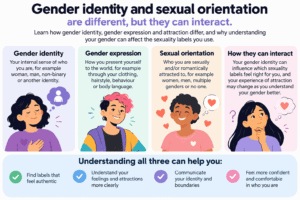
You may know that you can feel attraction to more than one gender while still being unsure what to call yourself. Perhaps bisexual feels close but incomplete. Maybe you also relate to pansexual, queer, fluid, questioning, biromantic, greysexual, or another term.
Other people feel connected to the word bisexual without wanting to analyse every difference in their attraction. Some prefer no label at all.
None of these experiences automatically makes someone confused, dishonest, or less valid.
Labels can give people recognition, language, and community. They can also become stressful when treated as strict rules that must describe every thought, relationship, preference, and possible future.
Thinking about bisexuality beyond labels creates room for a simpler principle:
A label should help you understand yourself. You should not have to reshape yourself to satisfy the label.
If you are still exploring, you may also find it helpful to read Am I Bisexual? Signs, Questions & What It Really Feels Like, Feeling “Not Bi Enough”?, and Do You Need a Label as a Bisexual?
What Does Bisexuality Beyond Labels Mean?
Bisexuality generally describes the capacity to experience attraction to more than one gender. That attraction can be romantic, emotional, physical, sexual, or a combination of these.
Beyond that basic description, bisexual experiences can differ considerably.
- Attraction may be stronger toward one gender.
- Romantic and sexual attraction may follow different patterns.
- Preferences may change over time.
- Attraction may depend strongly on trust or emotional connection.
- Someone may feel attracted to several genders but date only one.
- A person may rarely experience attraction while still knowing it is not limited to one gender.
Bisexuality beyond labels does not mean that the word bisexual has no meaning. It means the word can describe a broad human experience without requiring every bisexual person to experience attraction in the same way.
The label offers a useful framework. It does not need to become a detailed instruction manual for your entire life.
Why Bisexuality Can Be Difficult to Define
Many people grow up hearing sexuality described as two opposite paths. Someone is expected to be attracted either to another gender or to the same gender.
Bisexuality challenges that binary idea.
Even when bisexuality is acknowledged, it may be presented as a perfect 50/50 split between men and women. That narrow definition excludes many real bisexual experiences and can overlook non-binary people entirely.
Human attraction is rarely so easy to measure.
You may experience:
- frequent attraction to one gender and occasional attraction to another;
- different types of attraction depending on gender;
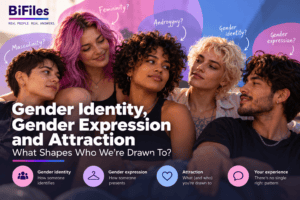
- attraction to masculinity, femininity, androgyny, or particular personal qualities;
- strong attraction to one individual without developing a broader preference;
- changes in attraction during different stages of life;
- feelings that are difficult to separate into romantic and sexual categories.
These differences do not make bisexuality meaningless. They show why one simple pattern cannot represent everyone.
Bisexuality Beyond Labels Does Not Require a 50/50 Split
You do not have to experience equal attraction to different genders to be bisexual.
One person may feel attracted to women much more frequently while occasionally experiencing genuine attraction to men. Another may usually date men while also recognizing romantic or sexual attraction to women or non-binary people.
Someone else may feel that their attraction changes over time.
None of these people needs to calculate a percentage before using a label that helps them understand themselves.
Bisexuality is not a mathematical balance. It is a capacity for attraction that is not limited to one gender.
A strong preference does not automatically erase bisexuality. Rare attraction can still be meaningful attraction.
For more about uneven or changing attraction, read Am I Bisexual If My Attraction Changes Over Time?
Romantic and Sexual Attraction May Not Match
Some people experience romantic and sexual attraction in different ways.
You might feel romantic attraction toward more than one gender while experiencing sexual attraction rarely. Another person may feel physical attraction broadly but imagine long-term relationships more easily with one gender.
Examples can include:
- feeling sexually attracted to several genders but romantically drawn mainly to one;
- experiencing romantic attraction without much sexual attraction;
- needing emotional closeness before sexual attraction develops;
- feeling physical attraction without wanting a relationship;
- experiencing attraction differently depending on trust, safety, or context.
Some people use terms such as biromantic, bisexual, homoromantic, heteroromantic, demisexual, asexual, or greysexual to describe these differences.
Others find that detailed labels create more pressure than clarity and simply use bisexual or queer.
You are not required to map every part of your attraction before your experience becomes real.
Can You Be Bisexual and Asexual or Greysexual?
Yes. Bisexuality can overlap with identities on the asexual spectrum.
Bisexuality can describe the genders toward whom someone experiences attraction, while terms on the asexual spectrum describe different patterns of sexual attraction. Asexual people experience little or no sexual attraction; greysexual people experience it rarely, to a limited degree, or under particular circumstances. Demisexual people generally experience sexual attraction only after developing a strong emotional bond.
Demisexuality is about how sexual attraction develops, not simply choosing to wait until there is trust before having sex. Likewise, being asexual does not automatically mean someone cannot experience romantic attraction or form a close relationship.
A person might rarely experience sexual attraction while still recognizing that it is not limited to one gender. Someone else may experience romantic attraction toward several genders without experiencing sexual attraction at all.
Possible combinations include:
- bisexual and greysexual;
- biromantic and asexual;
- bisexual and demisexual;
- biromantic and demisexual;
- queer and somewhere on the asexual spectrum.
More than one label may be useful when each word describes a different part of your experience.
Using fewer labels is equally valid.
For related questions about attraction and overlapping identities, visit the Identity & Attraction FAQ guide.
To compare experiences and discuss how bisexuality can overlap with the asexual spectrum, read or reply to Can You Be Bisexual and Asexual, Greysexual, or Demisexual? in the BiFiles Forum.
Bisexual, Pansexual, Queer, or Fluid?
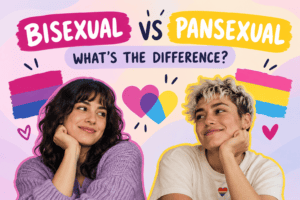
Bisexual, pansexual, queer, and sexually fluid can overlap, but people do not always use them in exactly the same way.
Bisexual
Bisexual usually describes attraction to more than one gender. It does not require attraction to only men and women, equal attraction, or a gender binary.
Pansexual
Pansexual is often used by people who feel that gender is not a major limiting factor in their attraction. Some describe it as attraction regardless of gender.
Queer
Queer is a broad term that some people use when a more specific label feels too narrow, when several identities overlap, or when they prefer not to explain every detail.
Sexually Fluid
Sexually fluid may describe attraction that changes over time or responds strongly to different individuals and situations.
There is no universally enforced border between these terms. Two people with similar attraction patterns may choose different labels because the words carry different personal, cultural, or community meanings for them.
You do not have to prove that one term is objectively superior before choosing it.
Can You Use More Than One Label?
Yes. Some people use several labels because each one communicates something useful.
You might identify as:
- bisexual and queer;
- bisexual and pansexual;
- bisexual and demisexual;
- biromantic and asexual;
- bisexual and gender-fluid;
- bisexual, queer, and questioning.
Different words can describe attraction, romantic orientation, gender, relationship structure, or community connection.
Some people also use different language depending on context. Bisexual may be clearer when explaining orientation, while queer may feel more natural within a broader LGBTQ+ community.
Using more than one word does not automatically mean you are inconsistent. Language can provide several useful views of the same person.
What If Bisexual and Pansexual Both Feel Right?
Many people relate to both bisexual and pansexual definitions.
You may choose bisexual because it has personal history, community meaning, wider recognition, or simply feels more comfortable. Pansexual may feel more precise because gender does not strongly shape your attraction.
Another option is using both.
You do not need to enter a competition between the labels. Neither word automatically invalidates the other, and neither requires you to criticize how somebody else identifies.
The most useful question may be:
Which word helps me communicate my experience and feel most at home?
Do You Need a Microlabel?
Microlabels describe a more specific aspect of attraction, identity, or experience.
They can be helpful when a broad word leaves important details unexplained. Someone may feel relief after discovering a term that closely reflects how attraction works for them.
Microlabels can also become overwhelming when a person feels pressured to identify every possible variation before they are allowed to belong.
You may use a specific term when it helps. You may also decide that bisexual, queer, or no label gives you enough information.
The number of words you use does not measure how well you understand yourself.
Why Labels Can Feel Both Helpful and Limiting
Labels can give language to feelings that once seemed confusing. They help people find stories, community, support, and representation.
For someone who spent years feeling different without understanding why, discovering the word bisexual can feel like a door opening.
Problems arise when labels are treated as rigid rules.
You may begin to worry:
- Is my attraction balanced enough?
- Do I have enough experience?
- Am I allowed to use this word while married?
- What happens if my feelings change?
- Does another label fit slightly better?
- Will people accuse me of changing for attention?
A useful label should reduce confusion more often than it creates fear.
You are allowed to use bisexual while still having unanswered questions. The label does not require permanent certainty about every possible future attraction.
A Label Describes You; It Does Not Control You
Identity language can describe your present understanding without controlling every decision you make.
Identifying as bisexual does not require you to:
- date several genders;
- leave your current partner;
- explore sexually;
- come out publicly;
- join every LGBTQ+ space;
- make bisexuality central to your personality;
- retain the same label forever.
Your label does not make decisions for you.
Relationship choices, boundaries, disclosure, community involvement, and sexual behaviour remain separate questions.
Bisexuality Can Look Different From Person to Person
Bisexual people have different relationships, histories, cultures, and ways of experiencing attraction.
A bisexual person may be:
- single, dating, married, divorced, or celibate;
- monogamous, polyamorous, or unsure which structure fits;
- openly bisexual, selectively out, private, or questioning;
- experienced with several genders or with only one;
- young, middle-aged, or discovering bisexuality much later in life;
- deeply connected to queer culture or only quietly aware of the identity.
No single lifestyle proves bisexuality.
A person in a different-gender relationship can remain bisexual. Someone in a same-gender relationship can also remain bisexual. A person who has never dated is still allowed to understand their attraction.
Identity cannot be accurately determined by looking at one current partner.
Your Relationship Does Not Choose Your Label
People often assign an orientation based on the relationship they can see.
A woman with a man may be assumed straight. The same woman with a woman may be assumed lesbian. A man with another man may be treated as gay even when he identifies as bisexual.
These assumptions erase bisexuality by turning a current relationship into a complete identity.
Your relationship describes one particular connection. It does not display the full range of your attraction.
Your partner can be visible while your bisexuality remains real, even when other people cannot see it.
Marriage does not automatically make a bisexual person straight, gay, or lesbian. Monogamy also does not erase orientation.
Experience Is Not Proof of Identity
You do not need experience with several genders before recognizing bisexual attraction.
People often know who attracts them before dating or having sex. Straight people are rarely expected to complete a relationship history before their orientation is accepted.
Bisexual people deserve the same principle.
You may have:
- dated only one gender;
- never been in a relationship;
- recognized bisexuality while already married;
- experienced attraction without wanting to act on it;
- felt uncertain during a possible experience;
- chosen not to explore because of your values or commitments.
None of this automatically removes your right to identify as bisexual.
An experience can offer information, but it is not an examination you must pass.
What If Your Attraction Changes Over Time?
Attraction feels relatively stable for some people and more fluid for others.
You may experience periods when attraction toward one gender becomes much stronger. Months or years later, the balance may change again.
Some bisexual people call this the “bi-cycle,” although not everyone relates to that term.
A change in intensity does not automatically mean your former understanding was false. A quieter attraction does not erase previous feelings, and a powerful new attraction does not rewrite your entire history.
Your label can remain the same while your experience shifts.
Alternatively, you may decide that another word describes you more accurately now. Both possibilities are legitimate.
What If Your Label Changes?
A label can change because attraction changed, because your understanding became clearer, or because new language became available.
You might once have identified as straight, gay, lesbian, asexual, pansexual, or questioning. Later, bisexual may fit better.
The reverse may also happen. Someone who previously used bisexual may later prefer pansexual, queer, lesbian, gay, asexual, or no label.
Changing language does not automatically prove that the former identity was dishonest.
Your earlier label may have been the most honest word available to you at that time.
People learn, grow, gain experience, and reinterpret their feelings. Updating a label can be an act of honesty rather than inconsistency.
For a focused discussion about changing identity language, read or reply to What If the Label That Once Fit You Starts to Feel Different? in the BiFiles Forum. You can read without an account and create a free account when you want to reply.
Previously Identifying as Straight, Gay, or Lesbian
Recognizing bisexuality after using another orientation label can feel emotionally complicated.
A person who lived as straight may question whether their earlier relationships were genuine. Someone who previously identified as gay or lesbian may fear losing community, history, or an identity that once brought safety and belonging.
New self-understanding does not automatically erase old relationships or community connections.
You can acknowledge:
- that an earlier label was meaningful;
- that your present understanding is broader;
- that changing language may involve grief;
- that other people may need time to adjust;
- that you still deserve to describe yourself accurately.
You do not owe everyone a detailed defence of why your identity changed.
The Pressure to Pick a Side
Bisexual people are often pressured to choose between straight and gay or lesbian identities.
That pressure can come from relatives, partners, straight communities, LGBTQ+ spaces, or internalized doubt.
Common assumptions include:
- bisexuality is temporary;
- the gender of your partner reveals what you “really” are;
- you eventually need to select one side;
- bisexual people are avoiding a more honest identity;
- a relationship automatically settles the question.
Bisexuality is not a waiting room between straight and gay. For many people, it is the accurate destination.
You do not have to simplify yourself to make another person’s categories more comfortable.
Bisexuality Beyond Labels and Queer Gatekeeping
Some bisexual people feel excluded from LGBTQ+ communities because their life does not appear queer enough from the outside.
Gatekeeping may affect people who:
- are dating someone of a different gender;
- have little same-gender relationship experience;
- came out later in life;
- are not publicly out;
- present in a conventionally masculine or feminine way;
- do not attend Pride events or queer social spaces;
- use bisexual instead of a label someone else prefers.
Your visibility does not determine your validity.
A community should not require you to perform one approved version of bisexuality before allowing you to belong.
For more support around this doubt, read Feeling “Not Bi Enough”? Why So Many Bisexual People Struggle With This.
Questioning Does Not Make You Fake
Questioning can feel uncomfortable when you want a clear answer quickly.
You may worry that uncertainty means you are overthinking ordinary friendship, admiration, or curiosity. Perhaps you fear choosing the wrong label or being accused of seeking attention.
Questioning is often part of self-awareness rather than evidence of dishonesty.
It can take time to separate:
- admiration from attraction;
- friendship from romantic interest;
- fantasy from desire for action;
- gender envy from physical attraction;
- emotional closeness from romantic connection;
- social expectations from personal truth.
You do not need to rush into a permanent conclusion.
A more useful question than “Which label must I choose today?” may be:
What feels honest about my experience right now?
Bisexuality and Imposter Syndrome
Many bisexual people experience imposter syndrome because their lives do not match a visible stereotype.
You may feel like an outsider because:
- your current relationship looks straight;
- you have more experience with one gender;
- you discovered bisexuality after marriage;
- attraction is rare or uneven;
- you are private rather than publicly out;
- you relate to several labels;
- bisexuality is not a central part of your daily life.
These doubts are often created by external expectations rather than by your actual feelings.
You are not required to present visible evidence before your identity counts.
Culture, Religion, and Language Can Shape Labels
Identity words do not exist outside culture.
Your language, family, religion, country, generation, and social environment may influence which labels feel available or safe.
Some people grow up without a familiar word for bisexuality. Others know the term but only hear it used as an insult, joke, stereotype, or sexual category.
A person may therefore understand attraction long before they feel able to claim an identity.
Different languages may also use terms that do not translate perfectly into English LGBTQ+ labels.
You are allowed to choose language that works within your own life. Nobody should demand a Western or highly specific label before respecting your experience.
You Can Keep Your Label Private
Understanding yourself does not create an obligation to inform everyone else.
You may use bisexual privately, tell only selected people, or remain publicly unlabeled.
Privacy can matter because of:
- family safety;
- work or school;
- housing and finances;
- religious community;
- relationship circumstances;
- personal preference;
- the need for more time.
A private identity is still an identity.
You may find Do I Have to Come Out as Bisexual? helpful when deciding who needs to know.
When Other People Do Not Understand Your Label
People may question your identity, debate definitions, ask invasive questions, or reduce bisexuality to your current partner.
You are allowed to set boundaries rather than repeatedly defending yourself.
Possible responses include:
- “Bisexual is the word that feels right for me.”
- “My attraction does not need to be equal.”
- “My current relationship does not define my entire orientation.”
- “I use more than one label, depending on context.”
- “I am still questioning and do not need a final answer yet.”
- “I do not want to discuss personal details.”
Understanding yourself is more important than winning every argument about terminology.
You Do Not Need a Label at All
Some people understand their attraction clearly but do not want an identity label.
You might prefer to say:
- “I am attracted to more than one gender.”
- “I like people rather than one specific gender.”
- “My sexuality is private.”
- “I am still figuring it out.”
- “I do not use a label.”
A label can make communication easier, but refusing one does not erase your experience.
Community participation should not depend on having a finalized identity statement.
You can seek support while questioning, unlabeled, bi-curious, or uncertain.
How to Choose Language That Feels Right
Think of identity language as a tool rather than a test.
You can try a label privately before using it publicly. Write it in a journal, say it quietly, read other people’s stories, or use it anonymously in a supportive community.
Consider asking:
- Does this word help me understand my experience?
- Do I feel relief when I use it?
- Does it connect me with people who share similar questions?
- Am I rejecting it because it feels inaccurate or because I fear judgment?
- Would a broader or more specific label feel more comfortable?
- Do I need a label for myself, for communication, or for community?
The best word is not necessarily the most technically detailed one. It is the language that helps you communicate honestly and live with less pressure.
Questions That May Help You Reflect
These questions can help when your attraction does not fit neatly into one category:
- Have I experienced genuine attraction to more than one gender?
- Does that attraction feel romantic, sexual, emotional, or different depending on the person?
- Am I dismissing feelings because they are rare or unequal?
- Does my relationship history make me doubt my internal experience?
- Am I searching for a useful label or a perfect explanation?
- Would bisexual, pansexual, queer, fluid, or unlabeled give me more room?
- Am I afraid that changing labels will make my past look dishonest?
- Which word makes me feel recognized rather than restricted?
These questions are not a quiz. No minimum score is required.
Their purpose is to help you listen to yourself without forcing an answer too quickly.
You Are Allowed to Be Unfinished
You do not have to understand every part of yourself before your feelings become real.
Your attraction may be clear while the right language remains uncertain. A label might fit today and feel incomplete later. Perhaps you will keep the same word for decades while your understanding of it becomes more nuanced.
All of these possibilities are human.
Bisexuality can feel steady, fluid, simple, complex, joyful, frightening, private, public, or several of these things at different times.
Uncertainty does not remove your right to respect and community.
I am still learning who I am, and I deserve patience while I do.
Bisexuality Beyond Labels Does Not Mean Bisexuality Is Meaningless
Talking about identity beyond labels does not mean every label is interchangeable or that words have no purpose.
Bisexual has history, community, political meaning, and personal value. It helps many people recognize that attraction beyond one gender is real and shared by others.
The goal is not to remove meaning from bisexuality. It is to prevent a useful word from becoming a narrow standard that excludes the people it was meant to describe.
Bisexuality can remain meaningful while allowing:
- unequal attraction;
- changing preferences;
- non-binary attraction;
- asexual-spectrum experiences;
- different relationship histories;
- overlapping labels;
- private identities;
- continued questioning.
A broad identity is not necessarily a vague identity. It can be broad because human experiences are diverse.
Bisexuality Beyond Labels: Final Thoughts
Bisexuality does not always fit into neat boxes because people do not always fit into neat boxes.
Attraction can be unequal, changing, rare, intense, romantic, sexual, emotional, or difficult to separate. Your dating history may represent only one part of what you feel.
You may use bisexual, pansexual, queer, fluid, questioning, several labels, or no label at all.
None of these choices requires a public explanation or permanent promise.
Labels can offer recognition and community. They should not become another reason to distrust yourself.
You are not less valid because your attraction is complicated. A changing label does not automatically make your past dishonest. Unequal experience does not make you less bisexual.
Bisexuality beyond labels means allowing your identity to be honest, personal, and more complex than someone else’s checklist.
The right label is the one that helps you understand yourself without requiring you to erase parts of your experience.
Explore More on BiFiles
If you are exploring labels, changing attraction, imposter syndrome, relationships, or later-in-life discovery, these BiFiles resources can help you continue without pressure to define everything immediately.
- Am I Bisexual? Signs, Questions & What It Really Feels Like
- Am I Bisexual If My Attraction Changes Over Time?
- Feeling “Not Bi Enough”? Why So Many Bisexual People Struggle With This
- Do You Need a Label as a Bisexual? Identity, Freedom and Self-Acceptance
- Do I Have to Come Out as Bisexual?
- I’m Married and Think I Might Be Bisexual. What Do I Do?
- Explore the BiFiles Bisexual Online Community
You can also explore the wider BiFiles Network at your own pace:
- Visit BiFiles Support & FAQ
- Read More BiFiles Articles
- Browse Community Stories
- Browse the BiFiles Forum
- Open BiFiles Chat
For broader information outside BiFiles, the Bisexual Resource Center FAQ also answers common questions about bisexuality and identity.