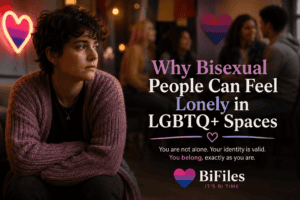
I’m Not Ready to Post. Do I Still Belong?

If you are not ready to post or reply in a bisexual community, you still belong. You do not have to introduce yourself, explain your history, join every conversation, or prove that you are active enough before a community can help you.
Many people begin by reading quietly. They observe how members speak to each other, look for questions that resemble their own, and decide whether the space feels safe enough to trust.
That quiet stage is not failure. It is often how trust begins.
You may be bisexual, bi-curious, questioning, married, private, newly out, later in life, or unsure which label fits. None of those circumstances require you to speak before you feel ready.
On BiFiles, you can begin with Support & FAQ, read Articles, browse Community Stories, observe the Forum, or explore Chat at your own pace.
Not Ready to Post? You Still Belong
Some people join a bisexual community and begin talking immediately. Others watch quietly for days, months, or much longer.
They may read discussions, recognize parts of themselves, close the page, and return later. Over time, the language becomes more familiar and the feeling of being alone may begin to soften.
That process matters even when nobody else can see it.
Community is not created only by the people who reply most often. It also exists for those who need information, recognition, or a calm place to observe.
You do not have to become visible before you are allowed to feel less alone.
Reading Quietly Is a Real First Step
Quiet reading can help you understand the language, tone, boundaries, and culture of a community before you participate.
You may discover that other people have asked the questions already circling in your mind:
- Am I bisexual?
- Can I be bi if I have only dated one gender?
- Do I have to come out?
- Does my marriage change my orientation?
- Why does my attraction seem to shift?
- Am I welcome if I am still questioning?
- What happens if I never want to share my full story?
Seeing thoughtful responses to those questions can provide support before you are ready to ask anything yourself.
Sometimes reading is avoidance. In many other cases, it is preparation, learning, or self-protection.
A gentle starting point is the BiFiles Support & FAQ page, where recurring questions are answered without requiring you to join a discussion.
Why Posting About Bisexuality Can Feel Scary
Posting about identity can feel unusually vulnerable. A question that seems small on the screen may represent years of uncertainty, secrecy, shame, or private reflection.
You may worry that:
- your question is too basic;
- other people will judge your relationship history;
- someone will tell you that you are not bisexual;
- your situation is too complicated to explain;
- writing the words will make everything feel more real;
- a friend, colleague, relative, or partner may recognize you;
- people will sexualize your question;
- you will receive advice you are not ready to hear;
- nobody will respond.
These fears do not mean you are weak or that you do not belong. They may simply mean you are protecting something personal.
Replying should be an available option, not an entrance requirement.
You Do Not Have to Explain Your Whole Story
Joining a community does not require a complete account of your life.
You do not automatically owe people details about:
- your sexual experiences;
- your current or former partners;
- your marriage;
- your fantasies;
- your family;
- your coming-out status;
- trauma or mental health;
- your exact location;
- the labels you previously used.
A short question can be enough. You may say that you are still figuring things out, remove identifying details, or ask for general perspectives rather than personal advice.
Another valid choice is not replying at all.
Your privacy does not make your experience less real.
Quiet Members Are Still Part of a Community
A healthy community is not made only by its most visible members.
Quiet members read, learn, reflect, and carry useful ideas into their own lives. Some later leave a short reply. Others ask one careful question within an existing discussion and then return to reading.
Many people never become frequent posters but still benefit from knowing that the space exists.
Belonging does not always look like public participation. Sometimes it means finding a place where you no longer need to pretend that your questions are unique or unacceptable.
Wondering whether quiet participation still counts? Read or reply to Can You Still Belong If You Are Not Ready to Reply? in the BiFiles Forum. You can read without an account and create a free account when you want to reply.
Being Private Does Not Automatically Mean You Are Ashamed
Privacy and shame can overlap, but they are not the same.
You may stay private because:
- you are not publicly out;
- home or work does not feel safe;
- your relationship situation is sensitive;
- family members may react badly;
- you are still questioning;
- your culture or religion makes disclosure difficult;
- online sharing does not feel natural to you;
- you simply value privacy.
None of these reasons requires an apology.
You do not have to become public, loud, or instantly confident before taking bisexuality seriously.
For more guidance about privacy and disclosure, read Do I Have to Come Out as Bisexual?
You Can Belong Before Choosing a Label
Some people hesitate to participate because they do not yet know which label fits.
You may be considering bisexual, bi-curious, queer, pansexual, questioning, fluid, heteroflexible, homoflexible, or no label at all.
A supportive community should not demand a final identity statement before allowing you to learn.
You can participate while saying:
- “I am still questioning.”
- “Bisexual might fit, but I am not certain.”
- “I know what I feel, but I do not know which word to use.”
- “I am here to learn rather than choose a label today.”
BiFiles is intended for bisexual, bi-curious, questioning, and supportive people—not only those who have everything neatly resolved.
When labels feel difficult, read Do You Need a Label as a Bisexual? and Bisexuality Beyond Labels.
You Can Join While Married or in a Relationship
People in long-term relationships may feel especially nervous about entering bisexual community spaces.
You may worry that joining a community will look like seeking dates, preparing to leave your partner, or announcing that something is missing from the relationship.
Seeking information or support does not automatically mean any of those things.
You may simply need:
- language for your identity;
- recognition from people with similar experiences;
- help discussing bisexuality with a partner;
- reassurance that monogamy and bisexuality can coexist;
- a place to process a later-in-life realization;
- support that is separate from dating or sexual exploration.
A well-moderated support space should not assume that every married bisexual person wants to experiment or change their relationship structure.
You may also find I’m Married and Think I Might Be Bisexual. What Do I Do? helpful.
Later-in-Life Questioning Can Make Posting Feel Harder
Discovering or acknowledging bisexuality later in life can bring particular worries.
You may feel out of place in conversations focused on school, first dates, or coming out to parents. A long relationship history might make your situation difficult to summarize.
Other concerns can include:
- feeling embarrassed that recognition took so long;
- worrying that younger members will not understand;
- grieving missed experiences;
- questioning whether bisexuality matters after decades of marriage;
- fearing that people will tell you to make drastic changes;
- feeling too old to enter an LGBTQ+ space for the first time.
There is no age limit on self-understanding or community support.
You do not need to compress decades of life into one introductory post. Begin only with the part you want help understanding now.
Start With the Lowest-Pressure Format
Different community formats create different levels of exposure and interaction.
On BiFiles, you might begin with:
- Support & FAQ: short answers to recurring questions.
- Articles: deeper explanations about identity, relationships, and self-acceptance.
- Community Stories: personal recognition without needing to respond.
- Forum: slower, topic-based conversations that allow more time to think.
- Chat: more immediate interaction when you want live conversation.
- Reviews: trust-focused information about dating apps and platforms.
You do not need to begin with the most visible or interactive part of the network.
Choose the format that gives you enough control over pace, privacy, and emotional intensity.
A Low-Pressure Participation Ladder
Participation does not have to jump from silence to a detailed personal post.
You can move through smaller steps:
- Read public articles or FAQ answers.
- Browse older forum discussions.
- Observe how moderators handle difficult conversations.
- Save or bookmark helpful posts.
- Use a reaction without adding a reply.
- Reply with one short supportive sentence.
- Ask a general question within a relevant discussion without sharing personal details.
- Share a limited part of your own experience in a reply.
- Write a longer reply only when that feels useful.
You may stop at any stage. Progress is not measured by eventually sharing everything.
How to Prepare a First Reply Privately
Writing a draft reply outside the community can reduce pressure.
Before replying, consider:
- What is the main question?
- Which details are necessary for people to understand it?
- What information feels too identifying?
- Am I looking for advice, reassurance, experiences, or simply acknowledgment?
- Would I be comfortable if this reply were read outside the immediate discussion?
- Do I want private messages, or would I rather keep replies public?
A useful editing question is:
What is the smallest version of this question that still feels honest?
You can keep the longer version for yourself and reply only with what is needed.
Simple First-Reply Examples
Your first reply does not need to be dramatic or complete.
Possible first replies include:
- “I am new here and still figuring things out.”
- “I think I may be bisexual, but I am not ready to share much yet.”
- “Has anyone else felt nervous about joining a bi community?”
- “I have only dated one gender. Did that make anyone else question themselves?”
- “I am married and trying to understand my identity without rushing.”
- “I would appreciate gentle responses rather than advice about major decisions.”
- “I mainly want to know that I am not the only person who has felt this way.”
You may also tell readers what kind of response would help.
Clear requests can reduce the chance of receiving overwhelming or irrelevant advice.
Protecting Your Privacy Before Replying
No online space can guarantee absolute privacy. Even in a moderated community, other users may copy information or recognize details.
Before sharing, review:
- the name and photo attached to your profile;
- links to other social accounts;
- your workplace or exact location;
- the ages and identifying details of family members;
- unusual events that someone close to you may recognize;
- screenshots containing names, usernames, or notifications;
- whether search engines can index the page;
- the platform’s options for editing or deleting content.
Combining several harmless details can sometimes identify someone more easily than expected.
Share enough to receive useful responses without disclosing information that would create unnecessary risk.
You Can Set Boundaries After Replying
Replying does not give everyone unlimited access to you.
After leaving a reply or question, you may:
- stop replying when you feel tired;
- ignore unsolicited private messages;
- report harassment or sexual comments;
- clarify that you do not want dating invitations;
- decline to provide more personal information;
- leave the conversation temporarily;
- edit identifying details where the platform allows it;
- ask a moderator for help.
A clear response can be as simple as:
I appreciate the replies, but I am not comfortable sharing more detail or continuing this privately.
A good community should respect that boundary.
The BiFiles Safety & Community Guidelines explain the basic expectations for respectful participation across the network.
Unwanted Private Messages Are Not Your Fault
Vulnerable identity posts sometimes attract people who immediately ask to move the conversation into private messages.
A private conversation is not automatically unsafe, but pressure and secrecy are warning signs.
Be cautious when someone:
- asks for photos quickly;
- turns your identity question into sexual conversation;
- offers to help you “test” your bisexuality;
- discourages you from talking publicly;
- asks for your exact location;
- becomes angry when you do not reply;
- claims that only they understand you;
- pressures you to use another platform.
You are not rude for ignoring, blocking, or reporting someone who crosses your boundaries.
Seeking support is not consent to dating, flirting, sexual questions, or private access.
What If You Reply and Receive No Response?
A lack of response can feel personal, especially when it took courage to reply.
Silence does not necessarily mean your question was unimportant or unwelcome.
Possible reasons include:
- few members were active at that time;
- people related but did not know how to respond;
- your question was included inside a longer reply and was easy to miss;
- the existing discussion was not a close match for your question;
- members needed more context before they felt able to respond;
- the discussion was older and no longer receiving much activity.
You may add one clarification, reply to a more relevant discussion, or contact the BiFiles team when an important topic appears to be missing.
One unanswered reply does not determine whether you belong.
What If a Response Hurts or Invalidates You?
Even supportive communities contain imperfect people. Someone may misunderstand you, use careless language, or give advice that does not fit.
Consider whether the problem is:
- one poorly worded reply;
- a disagreement expressed respectfully;
- repeated gatekeeping;
- sexualization or harassment;
- a broader moderation problem.
You do not have to debate someone who denies your identity or pressures you into an unwanted decision.
Report serious problems and step away when the conversation stops being useful.
A community’s response to harmful behaviour often tells you more than the existence of one harmful comment.
You Are Allowed to Regret Replying
Sometimes people leave a reply and later feel exposed, anxious, or emotionally exhausted.
That reaction does not mean replying was foolish. Vulnerability can feel uncomfortable even when nothing objectively bad happened.
Give yourself permission to:
- take a break from checking replies;
- mute notifications;
- remove identifying details;
- ask moderators about available options;
- save useful responses before stepping away;
- decide that future replies or questions will be more general.
Learning your own limits is part of using online community safely.
What If You Never Reply?
Some people rarely reply, and some never reply at all.
You can still:
- learn through articles;
- feel recognized through personal stories;
- use short FAQ answers;
- make safer choices using reviews;
- read discussions about relationships and identity;
- share helpful information privately with a partner;
- carry new language and reassurance into your own life.
Participation is not the only measure of belonging.
Your identity does not have to be performed constantly in order to remain real.
How BiFiles Supports Quiet Readers
BiFiles is structured as a network because not everybody needs the same kind of support at the same time.
A quiet reader may begin with an article, move to an FAQ answer, browse a personal story, and only later decide whether the forum or chat feels useful.
Others may never join a live conversation but still use the information to understand themselves or communicate with a partner.
The network is intended to support several levels of participation:
- private reading;
- searching for a direct answer;
- observing community discussions;
- asking a short question;
- sharing lived experience;
- joining real-time conversation;
- helping another person feel understood.
No single level is required before your presence matters.
I’m Not Ready to Post. Do I Still Belong? Final Answer
Yes. You still belong when you are not ready to post.
Reading quietly can be a genuine form of learning, recognition, and connection. You do not need to reveal your identity, relationship history, label, location, or private experiences before receiving support.
You can begin with articles, FAQ answers, stories, or older discussions. When participation feels right, a short reply or carefully limited question within a relevant discussion is enough.
Boundaries remain valid after you post. You can stop replying, reject private messages, report unsafe behaviour, or step away.
Never becoming an active participant is also allowed.
You do not have to speak before you belong. Sometimes belonging begins when you finally find a place where you are allowed to listen.
Where to Go Next on BiFiles
These BiFiles resources offer different ways to explore bisexuality without pressure to share more than you want.
- Visit BiFiles Support & FAQ
- Explore the BiFiles Bisexual Online Community
- Am I Bisexual? Signs, Questions & What It Really Feels Like
- Do I Have to Come Out as Bisexual?
- Feeling “Not Bi Enough”?
- Bisexuality Beyond Labels
- I’m Married and Think I Might Be Bisexual. What Do I Do?
You can also explore the wider BiFiles Network at your own pace:
- Read More BiFiles Articles
- Browse Community Stories
- Visit the BiFiles Forum
- Open BiFiles Chat
- Explore BiFiles Reviews
For broader bi+ information and resources outside BiFiles, visit the Bisexual Resource Center resources.