Do You Need a Label as a Bisexual? Identity, Freedom and Self-Acceptance
Do you need a bisexual label before your feelings, questions, or attractions are valid? No. A label can help you understand yourself, communicate with others, and find community, but it is not an entrance requirement for self-acceptance.
Some people feel immediate relief when they discover the word bisexual. Experiences that once seemed disconnected begin to form a recognizable pattern. Others understand that their attraction is not limited to one gender but still feel uncomfortable choosing a fixed identity word.
Both responses can be honest.
A label should function as a useful tool. It should not become another test you have to pass, a permanent promise about your future, or a box that requires you to ignore parts of yourself.
This guide explores when a bisexual label may help, why labels can sometimes feel limiting, how to try language privately, what happens when labels change, and why choosing no label is also a valid option.
You may also find it helpful to read Bisexuality Beyond Labels, Am I Bisexual? Signs, Questions & What It Really Feels Like, and Feeling “Not Bi Enough”?
Labels can help you name your experience. They do not have to define every part of your life.
Do You Need a Bisexual Label? The Direct Answer
No. You do not need to use bisexual, queer, pansexual, questioning, or any other identity label before your feelings become real.
A label may be useful when it:
- helps you understand a recurring pattern of attraction;
- reduces confusion or shame;
- gives you language for talking with a partner;
- connects you with community and information;
- helps you feel recognized;
- allows you to describe yourself more honestly.
Choosing no label may be more comfortable when:
- you are still questioning;
- existing terms feel too narrow;
- the label creates more anxiety than clarity;
- you prefer to describe attraction without making it an identity;
- privacy or safety matters more than public definition;
- you simply do not feel a need for one.
Neither option is more mature, honest, or courageous by default.
The right amount of labeling is the amount that helps you live more honestly without making you feel trapped.
What Is an Identity Label For?
An identity label is a word people use to describe an aspect of themselves or a recurring pattern in their experience.
Sexuality labels can help communicate:
- who someone may be attracted to;
- how they understand their romantic or sexual orientation;
- which community or history they feel connected to;
- how they want others to describe them;
- which experiences or resources may be relevant.
A label is therefore a form of shorthand. It rarely explains everything.
Two people who identify as bisexual may experience attraction very differently. One may have a strong preference for one gender. Another may feel attraction that changes over time. A third may rarely experience attraction but recognize that it is not limited to one gender.
The shared label creates a useful connection without making those people identical.
Why a Bisexual Label Can Feel Empowering
Finding the word bisexual can feel like discovering that an experience you thought was unusual is shared by many other people.
The label may help explain:
- attractions you previously dismissed;
- why straight or gay never felt completely accurate;
- why your feelings toward different genders do not look identical;
- why your current relationship does not describe your full orientation;
- why certain stories or communities feel familiar;
- why you have repeatedly questioned yourself.
A shared word can also reduce isolation. Searching for bisexual experiences, articles, support, and communities becomes easier when you know which language to use.
For some people, saying “I am bisexual” creates a sense of belonging that softer language never provided.
That relief matters. It can be a sign that the label is serving its purpose.
Why Labels Can Also Feel Limiting
Labels become restrictive when other people treat them as rigid rules.
After identifying as bisexual, you may face questions such as:
- “Which gender do you prefer?”
- “Are you exactly 50/50?”
- “How many men and women have you dated?”
- “Are you still bisexual now that you are married?”
- “Why not call yourself pansexual instead?”
- “What happens if your attraction changes?”
- “How do you know without experience?”
Questions like these turn a useful word into a demand for evidence.
You may also begin monitoring yourself. Every crush, fantasy, preference, or quiet period of attraction starts to feel like evidence for or against the label.
When that happens, the label is no longer helping you describe your experience. You are trying to reshape your experience to protect the label.
A label should describe your life. Your life should not become a performance designed to defend the label.
Bisexuality Does Not Require a Perfect Definition
Bisexuality is commonly understood as attraction to more than one gender. Beyond that broad description, individual experiences vary.
You do not need:
- equal attraction to different genders;
- identical romantic and sexual feelings;
- constant attraction;
- relationships with several genders;
- a public coming-out story;
- a particular appearance;
- certainty about every future possibility.
Some people use bisexual to mean attraction to two or more genders. Others describe it as attraction to their own gender and genders different from their own. Many simply use it because attraction is not limited to one gender.
You do not need to solve every theoretical definition before deciding whether the word feels useful.
Can You Use a Bisexual Label While Still Questioning?
Yes. A label does not require permanent certainty.
You may honestly say:
- “I think I am bisexual.”
- “Bisexual is the closest word I have right now.”
- “I identify as bisexual, but I am still learning what that means for me.”
- “My attraction is not limited to one gender, although I still have questions.”
- “I am questioning and bisexual may fit.”
These statements are not contradictions. Identity language can reflect your best current understanding without pretending that no uncertainty remains.
Waiting is equally valid. Nobody has to claim a label before it feels comfortable.
You Can Try a Label Privately
Using a label does not have to begin with a public announcement.
You can try bisexual privately by:
- writing the word in a journal;
- saying it quietly to yourself;
- using it in an anonymous community;
- imagining introducing yourself with it;
- reading bisexual stories and noticing what resonates;
- telling one trusted person;
- using it internally without telling anyone.
Notice how the word affects you.
Does it bring relief, recognition, fear, resistance, peace, or pressure? Several emotions may appear at once.
Fear does not automatically mean the label is wrong. It may reflect concerns about family, culture, relationships, safety, or stereotypes.
Likewise, temporary excitement does not require you to keep the word forever.
A Label Is Not a Permanent Contract
Choosing bisexual today does not require you to use it for the rest of your life.
Your language may change because:
- your attraction changes;
- your understanding becomes clearer;
- you discover another term;
- an older word no longer feels comfortable;
- your relationship to community changes;
- you want broader or more specific language;
- you decide labels are no longer useful.
Changing a label does not automatically mean the previous one was dishonest.
An earlier label may have been the most accurate language available to you at that time.
People update how they describe themselves as they gain experience, confidence, vocabulary, and perspective.
That is often a sign of honesty rather than failure.
For a focused discussion about whether identity language brought clarity, belonging, or additional pressure, read or reply to Did Choosing a Label Help You—or Create More Pressure? in the BiFiles Forum. You can read without an account and create a free account when you want to reply.
What If You Are Afraid of Choosing the Wrong Label?
The fear of being wrong can make every identity decision feel much larger than it needs to be.
You may worry that:
- other people will accuse you of seeking attention;
- you will harm the bisexual community by using the word incorrectly;
- changing later will make you look dishonest;
- you need more experience before deciding;
- one unexpected future feeling will invalidate the label;
- you must choose between several overlapping terms perfectly.
A label is not a diagnosis that must be proven beyond doubt.
Use the word when it communicates something true and helpful about your present experience. Revise it when it no longer does.
The possibility of future change does not make present self-understanding meaningless.
Do You Need Experience Before Using a Bisexual Label?
No. Sexual or relationship experience is not required before recognizing attraction.
You may have:
- dated only one gender;
- never had sex;
- never kissed someone of the same gender;
- recognized bisexuality while already married;
- chosen not to explore because of monogamy;
- felt attraction without wanting to act on it.
None of these circumstances automatically makes a bisexual label dishonest.
People often understand who attracts them before entering a relationship. Bisexual people should not be held to a different standard.
Experience can provide information. It is not an identity examination you must pass.
Does a Strong Gender Preference Make the Label Wrong?
No. Bisexuality does not require equal attraction.
You may feel attracted to one gender frequently and another only occasionally. Romantic attraction could also differ from sexual attraction.
A strong preference may influence your dating history and future relationships. It does not necessarily erase genuine attraction beyond that preference.
The more useful question is not whether the balance is equal. Ask whether attraction is meaningfully present beyond one gender.
Read Am I Bisexual If My Attraction Changes Over Time? for more about uneven or shifting attraction.
Your Current Relationship Does Not Choose Your Label
People often assume someone’s sexuality based on their current partner.
A bisexual person in a different-gender relationship may be seen as straight. Someone in a same-gender relationship may be treated as gay or lesbian.
Neither assumption reveals the full range of that person’s attraction.
Your relationship describes one connection. It does not automatically define your entire orientation.
You can identify as bisexual while married, dating, single, celibate, monogamous, or not looking for a relationship.
Your label also does not require you to minimize the partner you chose. Acknowledging bisexuality and valuing your relationship can exist together.
Can You Be Bisexual and Monogamous?
Yes. Orientation and relationship structure are separate.
Bisexuality describes attraction. Monogamy describes an agreement to build an exclusive relationship with one person.
Using a bisexual label does not mean you must:
- date several genders;
- have multiple partners;
- open an existing relationship;
- explore every possible attraction;
- feel dissatisfied with one partner.
Your label explains something about attraction. It does not make relationship decisions for you.
For a complete guide, read Can You Be Bisexual and Monogamous?
Bisexual, Pansexual, Queer, or Questioning?
Several labels may describe overlapping experiences.
Bisexual
Bisexual commonly means attraction to more than one gender. It does not require equal attraction or exclude non-binary people.
Pansexual
Pansexual is often used by people who experience attraction regardless of gender or for whom gender is not a strong limiting factor.
Queer
Queer is a broad term that may feel more flexible when a specific category seems too narrow. Not everyone feels comfortable using it because of its history or cultural context.
Questioning
Questioning can be used when you are actively exploring or do not want to choose a more specific term yet.
There is no universal authority assigning these labels. Two people with similar attractions may choose different words because each label carries different personal and community meanings.
You may also use more than one label. Bisexual and queer, bisexual and pansexual, or bisexual and questioning can all feel accurate to different people.
Do You Need a More Specific Microlabel?
Microlabels describe a narrower pattern of attraction or identity.
They may help explain experiences such as:
- rare sexual attraction;
- attraction that develops only after emotional connection;
- romantic attraction without sexual attraction;
- strongly shifting attraction;
- a specific relationship between gender and attraction.
Finding a precise word can bring relief. It can also create pressure to catalogue every variation of your feelings.
You do not need the most detailed available label to prove that you understand yourself.
Bisexual may be specific enough. Queer may feel broad enough. No label may feel calmer.
Choose the level of detail that actually helps you.
Can You Use Several Labels?
Yes. Different labels may describe different parts of one person.
Examples include:
- bisexual and demisexual;
- biromantic and asexual;
- bisexual and queer;
- bisexual and pansexual;
- bisexual and gender-fluid;
- bisexual and questioning.
One term might describe the genders toward whom attraction can occur. Another may describe how or when attraction develops. A third could describe gender identity or community connection.
Using several labels is not inherently inconsistent. Each word may communicate a different dimension.
What If You Prefer No Label?
Some people understand their feelings but do not want an identity label.
You might say:
- “I am attracted to more than one gender.”
- “I like people rather than one particular gender.”
- “My sexuality is personal.”
- “I am still exploring.”
- “I do not use a label.”
- “I know what I feel without needing a category.”
No-label does not necessarily mean confused. It may represent a deliberate choice to keep your identity open, private, or less central.
A community should not require a completed identity statement before offering support.
You can be questioning, unlabeled, bi-curious, or uncertain and still benefit from bisexual resources and conversations.
Can You Come Out Without a Definite Label?
Yes. Coming out does not require a perfectly finalized word.
You can tell someone:
- “I have realized my attraction may not be limited to one gender.”
- “I think I may be bisexual, but I am still exploring.”
- “I do not have a final label, but I want to be honest about what I am feeling.”
- “Queer feels closest right now, although that may change.”
- “I am questioning and would appreciate patience.”
The purpose of disclosure may be honesty, support, or connection rather than announcing a permanent identity.
You also have the right not to come out.
Read Do I Have to Come Out as Bisexual? when deciding whether disclosure is useful or safe.
How to Explain an Uncertain Label to a Partner
A partner may want certainty because they fear that questioning means the relationship is unstable.
Explain what you know and what remains uncertain.
I know that my attraction is not limited to one gender. Bisexual may be the right word, but I am still understanding it. I am sharing my identity questions, not announcing a decision to leave or change our relationship.
When you do want a practical relationship change, discuss that separately and clearly.
Identity, attraction, action, and relationship agreements are related but distinct subjects.
For more guidance, read How to Talk to Your Partner About Being Bisexual.
Labels, Culture, Religion, and Safety
Identity language is shaped by the environment in which someone lives.
Your preferred label may be influenced by:
- the language you speak;
- family expectations;
- religious beliefs;
- the terms available while you were growing up;
- local laws and social attitudes;
- workplace or school safety;
- generational differences;
- which communities feel accessible.
Some people understand their attraction long before they feel safe using an LGBTQ+ label.
Others prefer words from their own culture that do not translate perfectly into English identity categories.
You do not need to adopt the most visible or internationally recognized label before your experience deserves respect.
You Can Keep Your Label Private
Choosing a label for yourself does not create an obligation to share it publicly.
You may identify as bisexual privately while presenting no public identity at all.
Selective disclosure may be appropriate when:
- family reactions could affect housing or finances;
- work or school is not safe;
- your relationship situation is sensitive;
- you need more time;
- public visibility does not interest you;
- you want one part of your life to remain personal.
A private bisexual label remains meaningful when it helps you understand yourself.
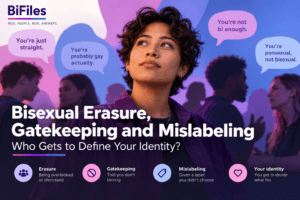
Dealing With Pressure to Pick a Side
Bisexual people are frequently pressured to identify as either straight or gay.
That pressure may increase when someone enters a long-term relationship.
Other people might say:
- “You chose a man, so you are straight.”
- “You married a woman, so you must be lesbian.”
- “Bisexuality was only a phase.”
- “Eventually you need to decide.”
- “Your current relationship reveals what you really are.”
A relationship choice does not necessarily reduce orientation to one gender.
You may respond:
My relationship tells you who I am with. It does not tell you every gender I can be attracted to.
You do not need to become easier to categorize for someone else’s convenience.
What If Other LGBTQ+ People Question Your Label?
Gatekeeping can occur inside LGBTQ+ communities as well as outside them.
You may be told that you are not bisexual enough because:
- you have little same-gender experience;
- you are in a different-gender relationship;
- you discovered bisexuality later;
- you are not publicly out;
- you have a strong preference;
- you use bisexual rather than another label;
- your identity is not highly visible.
Community terminology can be discussed respectfully. Nobody else should take complete ownership of your internal experience.
A label does not become more valid because you can perform it visibly enough for strangers.
When Label Questions Become Overwhelming
Reflection can become unhelpful when every feeling is analysed repeatedly.
You may find yourself asking:
- Was that attraction strong enough?
- Did that fantasy count?
- What percentage of my attraction belongs to each gender?
- Does a quiet week mean I am no longer bisexual?
- What if another label is technically more precise?
- Am I accidentally deceiving everyone?
When the search for certainty produces more panic than understanding, take a step back.
Helpful approaches include:
- stopping repeated online quizzes;
- looking for broad patterns rather than analysing every moment;
- accepting uncertainty temporarily;
- using a flexible label such as questioning or queer;
- choosing no label for a while;
- speaking with an LGBTQ+ aware counselor if anxiety is taking over daily life.
A counselor should not choose your sexuality for you. Support may still help reduce anxiety, shame, or compulsive self-analysis.
Questions That Can Help You Choose a Label
These questions are not a test. They are prompts for deciding whether a particular word is useful.
- Does bisexual describe a genuine part of my attraction?
- Do I feel recognized or restricted when I use the word?
- Am I rejecting it because it feels inaccurate or because I fear judgment?
- Would a broader label such as queer feel more comfortable?
- Would a more specific term provide useful clarity?
- Do I need a label for myself, for communication, or for community?
- Am I demanding permanent certainty before allowing present honesty?
- Would private use feel safer than public disclosure?
- Does no label currently give me more freedom?
- Which option helps me treat myself with greater honesty and less shame?
Different answers may matter at different times.
You do not need to choose the most intellectually precise word. Choose language that helps you communicate and understand yourself.
A Practical Way to Explore Labels
You can explore identity language gradually:
- Notice recurring patterns of attraction without forcing a conclusion.
- Read how several identity labels are commonly used.
- Write down which words feel close or uncomfortable.
- Try one privately.
- Observe whether it creates recognition or pressure.
- Use it with one trusted person when that feels safe.
- Keep, adjust, combine, or release the label as your understanding develops.
This process does not require dating, sexual experimentation, or public disclosure.
Language itself can be explored gently.
You Are Allowed to Remain Unfinished
You do not need to understand every part of yourself before receiving support or respect.
Perhaps bisexual feels right today. Another person may prefer questioning for several years. Someone else might never choose a label.
All three approaches can reflect honest self-awareness.
Your identity does not need a deadline. It also does not need to become permanently vague merely because change remains possible.
You are allowed to use the clearest language you have today while remaining open to what you may understand tomorrow.
Do You Need a Label as a Bisexual? Final Answer
No. You do not need a bisexual label before your attraction, questions, or experiences become valid.
The word bisexual can still be valuable. It may help you recognize patterns, communicate with a partner, find community, and understand that attraction beyond one gender is real.
A label should not require equal attraction, extensive experience, public disclosure, or a lifelong promise.
You may use bisexual while questioning, try it privately, combine it with another term, change it later, or decide that no label feels better.
Changing language does not automatically invalidate your past. Likewise, remaining unlabeled does not make you confused.
The most useful label is the one that helps you describe yourself without forcing you to erase parts of your experience.
Labels should create language and freedom—not another standard you must prove yourself against.
Explore More on BiFiles
These BiFiles resources can help you continue exploring labels, attraction, self-doubt, privacy, relationships, and bisexual identity.
- Am I Bisexual? Signs, Questions & What It Really Feels Like
- Bisexuality Beyond Labels: Why It Doesn’t Always Fit Into a Box
- Feeling “Not Bi Enough”? Why So Many Bisexual People Struggle With This
- Am I Bisexual If My Attraction Changes Over Time?
- Do I Have to Come Out as Bisexual?
- I’m Married and Think I Might Be Bisexual. What Do I Do?
- How to Talk to Your Partner About Being Bisexual
You can also explore the wider BiFiles Network at your own pace:
- Visit BiFiles Support & FAQ
- Read More BiFiles Articles
- Browse Community Stories
- Browse the BiFiles Forum
- Open BiFiles Chat
For broader information outside BiFiles, the Bisexual Resource Center FAQ answers additional questions about bisexuality, labels, and identity.