Bisexual Erasure, Gatekeeping and Mislabeling: Who Gets to Define Your Identity?
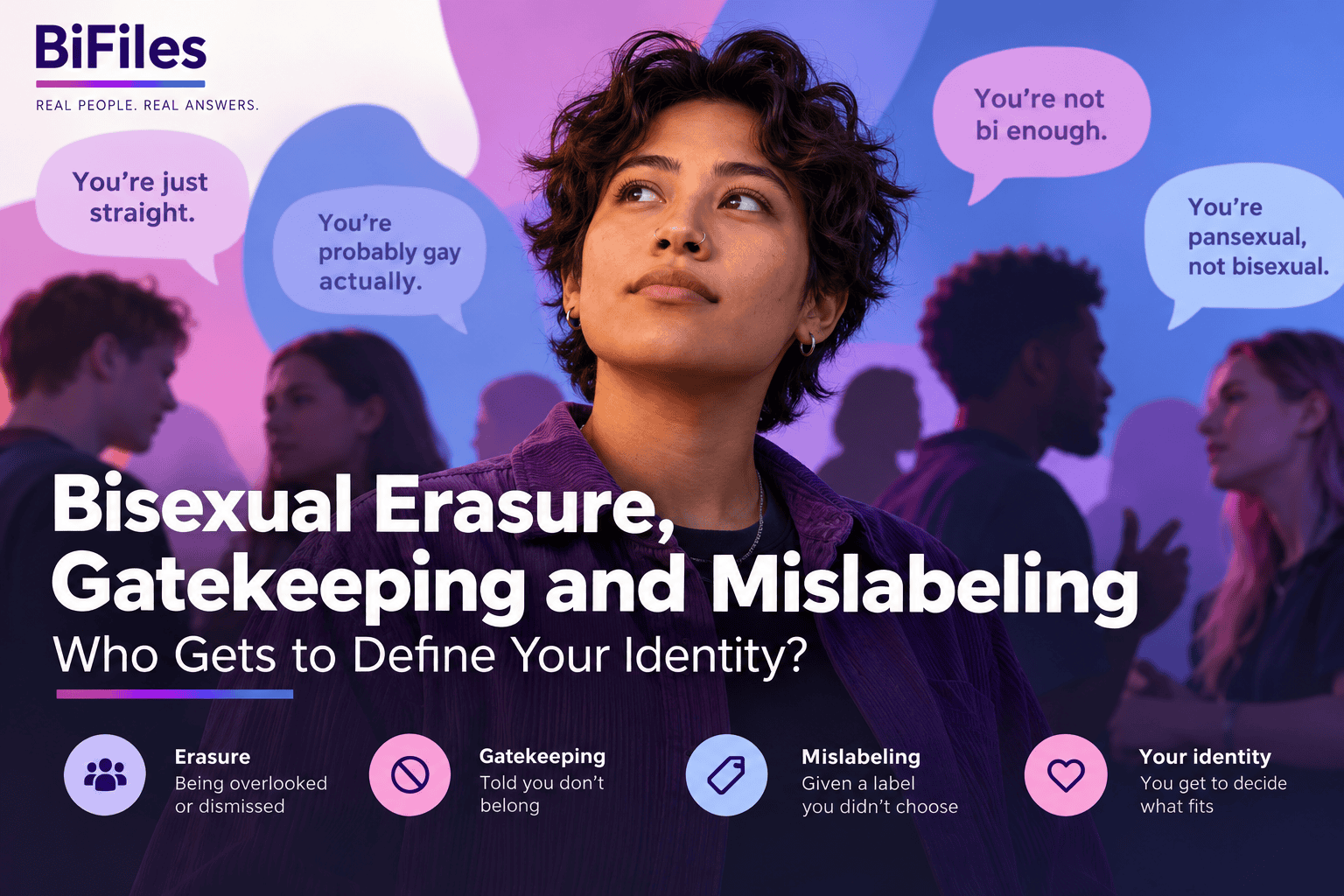
Being bisexual does not always mean being recognised as bisexual. Someone may call you straight because of your partner, gay because of a same-gender relationship, or pansexual because they think your understanding of bisexuality is wrong. Sometimes it happens in conversations with strangers. Sometimes it comes from friends, partners, or people in LGBTQ+ spaces where you expected to feel understood.
These experiences are often discussed as bisexual erasure, gatekeeping, and mislabeling. They overlap, but they are not quite the same. Understanding the differences can help you recognise what is happening, decide whether to respond, and find spaces where your identity does not have to be constantly defended.
What is bisexual erasure?
Bisexual erasure happens when bisexuality is overlooked, dismissed, or treated as if it cannot be a real or lasting orientation. This can be deliberate, but it can also happen through familiar assumptions that people do not stop to question.
- A bisexual woman dates a man and is automatically described as straight.
- A bisexual man dates a man and is told he must really be gay.
- Someone’s attraction to more than one gender is called a phase or a period of confusion.
- A bisexual person is asked for dating or sexual history as proof of their identity.
- A conversation about LGBTQ+ experiences talks only about straight, gay, and lesbian people, with bisexual experiences left out.
The common thread is that someone else’s assumption replaces what the person has said about themselves. A current relationship, a past experience, or an outsider’s impression is treated as more authoritative than the person’s own identity.
Your partner does not determine your orientation
One of the most persistent forms of erasure comes from reading a relationship as a complete description of sexuality. A bisexual person in a different-gender relationship may be seen as straight. In a same-gender relationship, they may be seen as gay or lesbian. Neither assumption tells you the whole story.
This can create two very different experiences. Someone whose relationship is perceived as straight may avoid certain kinds of public hostility while also feeling that their bisexuality has disappeared from view. Someone in a same-gender relationship may be visibly recognised as queer while still having their bisexual identity replaced with a gay or lesbian label.
Those experiences are not identical, and context matters. But both show why relationship appearance and sexual orientation should not be treated as interchangeable. Being single, married, monogamous, private, or inexperienced does not automatically cancel bisexuality.
If this feels familiar, you may also recognise the questions explored in Feeling “Not Bi Enough”? and Coming Out Twice: The Bisexual Experience.
What does gatekeeping look like in LGBTQ+ spaces?
Gatekeeping happens when people set informal tests for who counts as queer enough, bisexual enough, or entitled to belong. It may sound like a rule about labels, but often it is a rule about who is allowed recognition, visibility, or participation.
- “You are in a straight-looking relationship, so this space is not really for you.”
- “You have never dated more than one gender, so how would you know?”
- “If your attraction is stronger toward one gender, you are not bisexual enough.”
- “You cannot use that label because I define it differently.”
Not every LGBTQ+ group behaves this way, and many communities actively support bisexual people. Still, exclusion can feel especially painful when it happens in a space someone approached for understanding rather than judgment.
Gatekeeping also affects people differently. A bisexual person may have concerns shaped by their gender, race, disability, religion, culture, degree of openness, or relationship situation. There is no single bisexual experience, and a more inclusive community should not require everyone to have the same history.
Mislabeling: when someone insists you are straight, gay, or pansexual
Mislabeling is more specific: another person assigns you an orientation that you have not chosen, or keeps correcting the one you use. Sometimes they think they are helping. They might hear about your attraction and decide that, according to their definition, you must be straight, gay, lesbian, or pansexual instead of bisexual.
Explaining the meaning of different labels can be useful. Overruling someone else’s label is different. Bisexual and pansexual have meaningful histories and overlapping uses; they are not a simple test in which a stranger can calculate the one correct answer from your dating history.
In particular, bisexuality does not inherently exclude trans or non-binary people. Someone’s attraction to a trans or non-binary person does not automatically require them to identify as pansexual. Equally, a person who prefers pansexual, queer, or another description should not be pushed into calling themselves bisexual.
For a deeper comparison of the terms themselves, read Bisexual vs Pansexual: What’s the Difference — and Does It Matter?. Here, the concern is what happens when that discussion becomes an attempt to define someone else against their wishes.
Why can erasure and gatekeeping hurt?
One dismissive comment may be easy to brush off. Hearing the same message repeatedly—from family, dates, friends, online communities, or other LGBTQ+ people—can be different. Someone may begin to anticipate disbelief, avoid mentioning bisexuality, withdraw from community spaces, or question whether they are allowed to trust their own understanding.
That does not mean every bisexual person responds in the same way. Some find confidence in their identity despite other people’s assumptions; others need time, supportive relationships, or distance from a dismissive environment.
Research and community reports have documented how bisexual invisibility and stigma can affect belonging and well-being. The Movement Advancement Project’s Invisible Majority report examines bisexual-specific disparities and their relationship to stigma and invisibility. Stonewall’s research on bisexual openness also describes how fear of discrimination can shape decisions about who to tell. These findings describe wider patterns, not a prediction about any one person’s mental health or choices.
Is every question about your label gatekeeping?
No. Someone can be unfamiliar with bisexuality and ask a genuine, respectful question. It is possible to disagree about definitions without denying another person’s right to describe themselves.
Notice the difference between curiosity and correction. A person asking, “What does bisexual mean to you?” leaves room for your answer. A person repeatedly insisting, “No, you are really something else,” may be ignoring a boundary you have already made clear.
You are free to explain if you want to. You are also free to decide that this conversation is not useful, that it is too personal, or that you do not feel safe continuing it.
What can you do when someone invalidates your bisexual identity?
There is no response you owe everyone. Your options depend on the relationship, the setting, the person’s willingness to listen, and whether speaking up could affect your privacy or safety.
1. Use a short correction if you want to
You might say, “I’m bisexual, and that is the label I use,” or “My current partner doesn’t define my entire sexuality.” You do not need to provide a list of attractions or past experiences as evidence.
2. Set a boundary when the discussion becomes repetitive
For example: “I’m happy to answer a genuine question, but I’m not going to debate whether my identity is real.” A boundary can be calm and brief. You do not have to win the argument for the boundary to matter.
3. Choose privacy or distance where needed
If correcting someone could jeopardise your housing, job, family support, relationships, or personal safety, silence or a change of subject may be the safer option. Privacy is not agreement. You can also mute, leave, block, or report repeated harassment in online spaces.
4. Look for spaces that do not demand proof
A useful community lets people read quietly, participate at different levels, and describe their own histories without performing an ideal version of bisexuality. You may find that support from one thoughtful person matters more than persuading a dozen people who have already made up their minds.
What if your label changes later?
Self-description is not a lifetime contract. Someone might use bisexual for years and later prefer pansexual, queer, gay, lesbian, or no label. Another person may keep bisexual because it continues to fit. A change in language may reflect a new understanding, a shift in attraction, a different community connection, or simply a word that feels more comfortable.
That possibility does not give other people permission to predict your future or dismiss your present. Being open to personal change is not the same as accepting someone else’s forced label.
How can friends and LGBTQ+ communities do better?
Inclusion is not only about avoiding openly hostile remarks. It is also about everyday habits: not guessing orientation from a partner; using someone’s stated label; resisting demands for sexual or dating proof; and treating bisexual experiences as part of LGBTQ+ conversations, not an awkward exception.
Moderators and community organisers can make the expectation explicit: questioning ideas and discussing terminology are welcome, but repeatedly relabeling an individual after they have explained their identity is not respectful debate. That distinction leaves room for learning without making people’s identities a public vote.
For more practical allyship principles, see Stonewall’s guidance on supporting bi people.
Your identity does not need a public verdict
It is possible to be bisexual without having everyone understand you. You can know your own history, remain uncertain about parts of your attraction, choose a label that feels useful, or keep your identity private. None of those choices creates an obligation to persuade other people.
Bisexual erasure asks other people to overlook your experience. Gatekeeping asks you to meet someone else’s entry requirements. Mislabeling asks you to accept a description that is not yours. You can notice those pressures without letting them become the final authority on who you are.
Continue the conversation
Have you ever felt that someone else was trying to define your sexuality for you? Read other perspectives or share your experience in the BiFiles Forum discussion: Have You Ever Felt That Someone Else Was Defining Your Sexuality for You? You can read quietly first and reply only when you feel comfortable.
For shorter answers, visit the Community, Safety & Support FAQ. For related reading, explore Bisexuality Beyond Labels and Bisexual vs Pansexual.