Can You Be Bisexual and Monogamous?
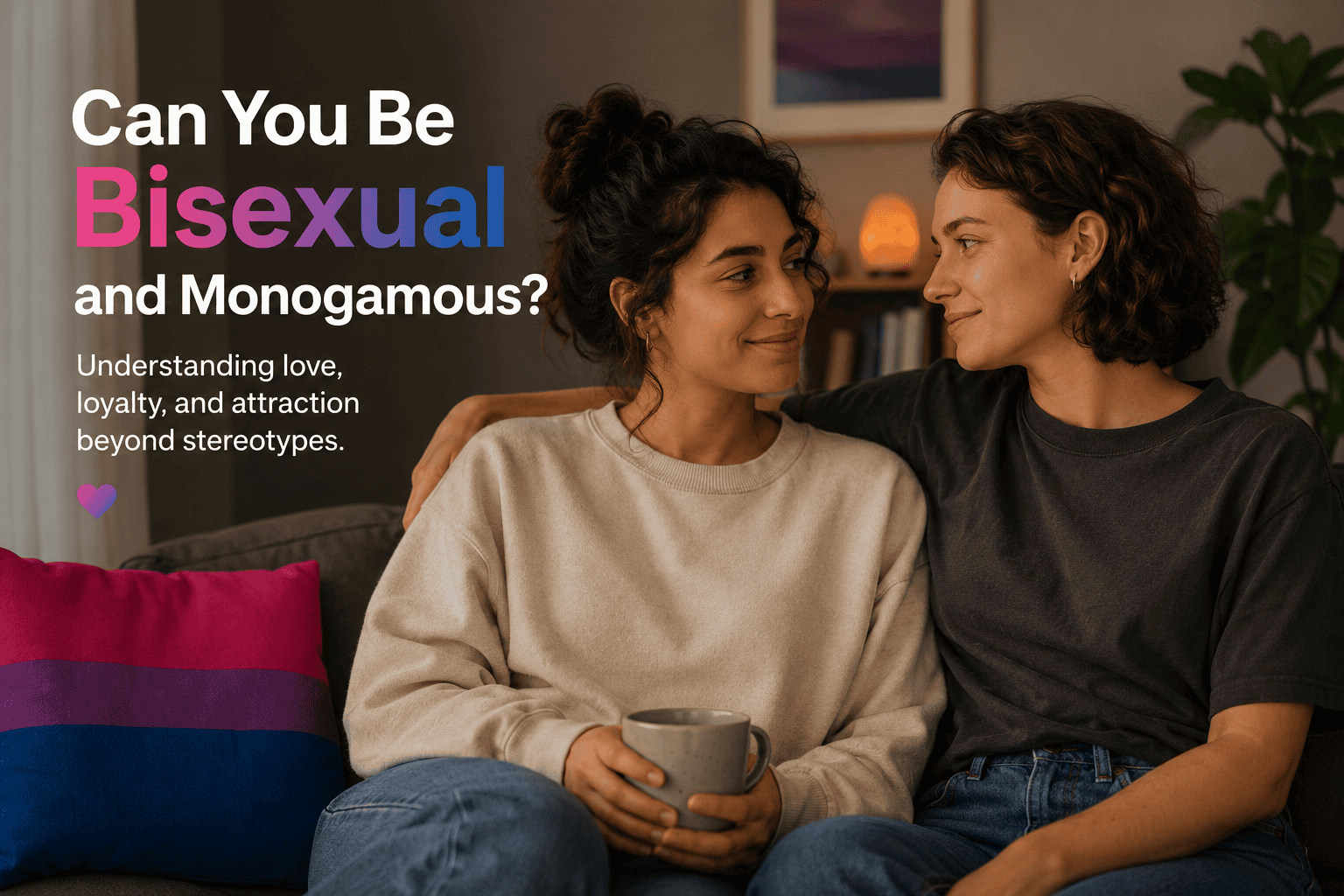
Yes, you can be bisexual and monogamous. Bisexuality does not mean someone cannot be loyal, committed, or happy with one partner.
Bisexuality describes the capacity to feel attraction to more than one gender. Monogamy describes a relationship agreement in which two people choose exclusivity with each other. One is an orientation. The other is a relationship structure.
They do not contradict each other.
Being bisexual and monogamous means your orientation remains valid while you choose to build a committed relationship with one partner.
A bisexual person can notice different kinds of people, fall deeply in love with one partner, and choose not to pursue anyone else. That is no different from a straight, gay, lesbian, pansexual, or queer person remaining committed while occasionally noticing someone attractive.
Your relationship may describe who you have chosen to be with. It does not define the full range of people you are capable of finding attractive.
This question connects closely with other common relationship concerns. You may also find it helpful to read Bisexuality & Relationships: Let’s Break the Biggest Myths, How to Build Trust with a Bisexual Partner, and How to Talk to Your Partner About Being Bisexual.
Can You Be Bisexual and Monogamous?
Absolutely.
Many people still misunderstand bisexuality because they confuse attraction with behavior. They assume that being attracted to more than one gender must mean wanting more than one partner.
But being capable of attraction is not the same as needing to act on every attraction.
A straight person in a monogamous relationship may still notice other people. A gay person may still find someone outside their relationship attractive. A lesbian may still have a celebrity crush. None of that automatically means they are unfaithful, unhappy, or searching for a replacement.
The same is true for bisexual people.
Monogamy does not require someone to stop having eyes, feelings, preferences, or a sexual orientation. It asks people to respect the agreements they have made with their partner.
Monogamy does not require blindness. It requires choices, boundaries, honesty, and commitment.
Why Being Bisexual and Monogamous Is Not a Contradiction
Attraction is often spontaneous. You may notice that someone is attractive without deciding to feel that way.
Intention is what you want to do with that feeling. Behavior is what you actually choose to do.
These are three different things:
- Attraction: noticing that someone appeals to you.
- Intention: deciding whether you want to pursue that attraction.
- Behavior: the actions you take and the boundaries you respect.
A person can experience attraction while having no intention of pursuing it. They can also deliberately redirect their attention toward the relationship they value.
That is not a uniquely bisexual experience. It is a normal part of many monogamous relationships.
Noticing someone is not the same as flirting with them. A passing crush is not the same as starting an affair. A fantasy is not the same as a plan. Attraction alone does not break a relationship agreement.
Being in Love Does Not Switch Off Attraction
Some people grow up with the romantic idea that falling in love means never noticing another attractive person again.
That may be true for some individuals, but it is not a universal measure of love or loyalty.
Many deeply committed people still notice attractive strangers, actors, friends, colleagues, or people online. What matters is not whether attraction ever appears. What matters is how someone responds to it.
A monogamous person might think:
That person is attractive, but I love my partner and I am not going to pursue this.
That is not a failure of monogamy. It is monogamy being actively chosen.
Some couples are comfortable talking openly about celebrity crushes or people they find attractive. Other couples prefer not to discuss those feelings. Neither approach is automatically better. The important thing is that both partners understand the boundaries of their relationship.
Someone who rarely notices other people is not automatically more faithful than someone who does. Faithfulness is shown through actions, honesty, and respect.
Your Current Partner Does Not Define Your Orientation
A bisexual person does not become straight when dating someone of a different gender. They do not become gay or lesbian when dating someone of the same gender.
Their relationship status may change. Their bisexuality does not automatically disappear.
A woman dating a man can still be bisexual. A man dating a man can still be bisexual. A bisexual person with a non-binary partner is still bisexual if that is the identity that fits them.
Orientation describes a person’s broader capacity for attraction. A relationship describes one particular connection.
Your partner can describe who you chose. They do not erase who you are capable of loving or finding attractive.
This is why bisexual people can remain bisexual throughout a long-term relationship or marriage, even when they never intend to date anyone else.
Why the Stereotype Hurts Bisexual People
The idea that bisexual people cannot be monogamous can create real harm.
It can make bisexual people feel distrusted before they have done anything wrong. It can make partners feel threatened by imaginary competition. It can also pressure bisexual people to hide their identity in order to appear safer, more loyal, or more serious.
Some bisexual people avoid coming out because they worry their partner will immediately ask:
- Does this mean you want someone else?
- Am I no longer enough?
- Are you going to cheat?
- Are you actually gay or straight?
- Do we need to open the relationship?
Others feel they have to constantly reassure their partner, explain every friendship, or prove that they are not going to leave.
That can become exhausting.
A healthy relationship should not require someone to apologize for their orientation. Trust should be based on honesty, behavior, communication, and respect — not on assumptions about who someone could theoretically find attractive.
Being Attracted to More Than One Gender Does Not Mean Being Unsatisfied
One of the biggest myths about bisexuality and monogamy is the belief that one partner can never be enough.
Some people imagine bisexuality as a constant need to have access to different genders. They assume that a bisexual person with a man must miss women, or that a bisexual person with a woman must miss men.
But many bisexual people do not experience relationships as a checklist of genders they need to complete.
They may choose a partner because of love, emotional safety, shared values, trust, kindness, chemistry, humor, compatibility, and the life they want to build together.
A partner is not interchangeable with an entire gender. Being attracted to different genders does not mean that people of those genders provide identical or replaceable experiences.
Someone can be fully in love, fully committed, and fully satisfied while remaining capable of attraction beyond their relationship.
Commitment does not erase attraction. Attraction does not invalidate commitment.
What If You Love Your Partner but Still Feel Unfulfilled?
Not every bisexual person experiences monogamy in the same way. Some feel fully satisfied with one partner, while others love their partner deeply and still grieve experiences they have not had or feel that part of their bisexuality remains unexplored. Neither experience makes someone less bisexual or automatically means their relationship is failing.
It can help to separate several questions: Do you want your bisexual identity to be acknowledged? Do you miss a particular kind of connection or experience? Are you feeling guilt about attraction or fantasies? Or are you considering a change to your relationship agreements? Those questions deserve different conversations, and recognizing a feeling does not obligate you or your partner to act on it.
It is possible to take feelings of loss or curiosity seriously while respecting a monogamous agreement. If either partner wants a different relationship structure, that requires an open discussion and freely given agreement from everyone involved. Neither partner owes the other sexual exploration, and neither should be pressured to accept an arrangement they do not want.
For focused guidance, explore the Relationships & Dating FAQ, including the question “What if I love my partner but feel unfulfilled because I cannot explore my bisexuality?” You can also read or reply to Does Coming Out as Bisexual Mean a Monogamous Relationship Has to Change? in the BiFiles Forum.
Monogamy Is About Agreement and Commitment
A strong monogamous relationship is built on shared expectations.
For many couples, monogamy means romantic and sexual exclusivity. Some couples also have boundaries around flirting, emotional intimacy, private messages, dating apps, pornography, contact with former partners, or physical affection with friends.
Different couples define these boundaries differently.
The important part is not assuming. The important part is talking.
Useful questions can include:
- What does monogamy mean to each of us?
- What behavior would feel like a boundary violation?
- Are we comfortable discussing crushes or attraction?
- What kinds of online interactions feel acceptable?
- How do we want to handle flirting or attention from other people?
- What helps each of us feel secure without becoming controlling?
Bisexual people do not need special restrictions because they are bisexual. But like anyone else, they benefit from clear and honest conversations about expectations.
Healthy monogamy is not built by controlling someone’s identity. It is built by understanding each other’s boundaries and choosing to honor them.
Talking About Attraction Without Creating Panic
Couples do not all need to talk about attraction in the same way.
Some partners can comfortably say that an actor, stranger, or mutual friend is attractive. Others find those conversations painful or unnecessary. Both reactions can be real.
The goal is not to force complete openness about every passing thought. The goal is to create enough safety that neither partner has to lie about who they are.
A bisexual person should not be required to report every attraction in order to prove honesty. At the same time, a partner’s feelings should not automatically be dismissed as irrational.
A balanced conversation might sound like:
I may occasionally notice other people, just as many people do. That does not mean I want to pursue them or that I am less committed to you.
The partner might respond:
I understand that attraction can happen. I would still like us to be clear about what behavior feels respectful in our relationship.
That kind of conversation separates normal attraction from actual relationship boundaries.
Partners May Need Reassurance, but Not Control
It is normal for a partner to have questions, especially if they have never knowingly dated a bisexual person before.
They may wonder what bisexuality means for the relationship, whether anything has changed, or whether they misunderstood part of their partner’s identity.
Questions are not automatically biphobic. The tone, assumptions, and repeated behavior matter.
A respectful question might sound like:
What does being bisexual mean for you personally, and is there anything you need from me?
A fear-based question might sound like:
Does this mean I am not enough for you?
That fear can be answered with care:
My bisexuality describes who I can be attracted to. My commitment describes who I have chosen. I am choosing this relationship with you.
Reassurance can be healthy when it is mutual and respectful. Control is different.
Constant accusations, checking someone’s phone, restricting friendships, demanding that bisexuality remain secret, or treating every person as a threat are not reasonable solutions to insecurity.
A bisexual person deserves reassurance too. They deserve to know that honesty about their identity will not automatically be punished.
Bisexuality Does Not Mean Polyamory
Bisexuality, monogamy, and polyamory describe different things.
- Bisexuality is a sexual or romantic orientation.
- Monogamy is a relationship agreement based on exclusivity.
- Polyamory is a relationship structure in which people may have more than one consensual romantic relationship.
A bisexual person can be monogamous. A straight person can be polyamorous. A gay person can prefer an open relationship. A pansexual person can want lifelong exclusivity with one partner.
Orientation does not automatically determine relationship structure.
Some bisexual people do prefer open relationships, polyamory, or another form of ethical non-monogamy. That is valid when everyone involved freely consents and communicates honestly.
But those choices are not caused by bisexuality alone, and they should never be assumed simply because someone comes out as bisexual.
For a focused discussion about this distinction, read or reply to Does Coming Out as Bisexual Mean a Monogamous Relationship Has to Change? in the BiFiles Forum. You can read without an account and create a free account when you want to reply.
Bisexual People Choose Monogamy for Many Reasons
Bisexual people choose monogamy for the same reasons many other people do.
- They value emotional security.
- They want to build a life with one partner.
- They prefer deep romantic focus.
- They feel safest in an exclusive relationship.
- Monogamy fits their values or personality.
- They simply do not want multiple relationships.
Bisexual people are not all the same. Some are monogamous. Some are not. Some are still discovering what works for them. Some may change their relationship preferences over time.
The important point is that bisexuality does not decide whether someone is monogamous.
The person, their values, their agreements, and their choices do.
What If You Are Bisexual and Afraid Your Partner Will Not Understand?
If you are bisexual and monogamous, you may still feel nervous about being open with your partner.
You might worry that they will misunderstand you, feel threatened, ask uncomfortable questions, or assume the relationship must change.
That fear is understandable, especially if you have heard negative stereotypes before.
You do not have to share everything before you feel safe. Coming out inside a relationship can be deeply personal. You are allowed to choose the right time, the right words, and the level of detail you want to share.
You might say:
I want to share something personal with you. I’m bisexual. That does not change my commitment to you or mean I want another relationship. It is part of who I am, and I want you to know me more fully.
You can also explain what the disclosure does and does not mean.
- It may mean you want to stop hiding part of yourself.
- It may mean you want more honest conversations.
- It may mean you want your identity acknowledged.
- It does not automatically mean you want to change the relationship.
- It does not automatically mean you need sexual experiences with other people.
This conversation is not a confession of wrongdoing. It is an invitation to greater honesty.
What If Your Partner Is Bisexual?
If your partner tells you they are bisexual, try to receive that information with respect. They may be sharing something they have hidden, questioned, or feared discussing for years.
Your first reaction can matter a lot.
You do not need to understand everything immediately. But you can avoid jumping to conclusions.
Helpful responses might include:
- Thank you for trusting me with that.
- I love you, and I want to understand what this means for you.
- Does this change anything you need from me?
- Is this something you have known for a long time?
- How can I support you without making assumptions?
Less helpful responses include immediately asking whether they will cheat, whether they are secretly unhappy, or whether they are “actually” gay or straight.
A bisexual partner is still the same person they were before they told you. What changed is that they trusted you with more of themselves.
Coming out may change the conversation. It does not automatically change the commitment.
Loyalty Is Not Determined by Sexuality
Loyalty is demonstrated through character and behavior, not orientation.
People of any orientation can be honest or dishonest. People of any orientation can be faithful or unfaithful. People of any orientation can communicate well or avoid difficult conversations.
A straight person does not become trustworthy merely because they are straight. A bisexual person does not become untrustworthy merely because their capacity for attraction includes more than one gender.
Someone’s actions, values, boundaries, and communication tell you far more about their relationship potential than their orientation ever could.
If someone is loyal, respectful, emotionally present, and committed, their bisexuality does not weaken that.
It is simply one part of who they are.
Can You Be Bisexual and Monogamous in a Long-Term Relationship?
Bisexual people in long-term relationships often experience invisibility.
If they are with someone of a different gender, other people may assume they are straight. If they are with someone of the same gender, people may assume they are gay or lesbian.
The relationship becomes visible while the bisexual identity disappears.
That can be painful, especially when people imply that marriage, monogamy, or a current partner has somehow cancelled bisexuality.
Being monogamous does not mean you stop being bisexual. Being married does not mean your identity is no longer relevant. Choosing one person does not require erasing the broader truth of who you are.
You can be deeply committed to your partner and still name your bisexuality.
You can be private about it or open about it. You can talk about it frequently or rarely. You can make bisexuality a central part of your identity or one quiet part of your story.
There is no single correct way to be bisexual in a monogamous relationship.
Common Questions About Bisexuality and Monogamy
Does noticing another person mean I do not love my partner?
No. Many people continue to notice attractive people while deeply loving their partner. Love is shown through how you treat your partner and the choices you make, not by never experiencing another spontaneous feeling.
Does being with a man make a bisexual woman straight?
No. A bisexual woman can remain bisexual while dating or marrying a man. Her partner does not erase her orientation.
Does being with a man make a bisexual man gay?
No. A bisexual man can be in a same-gender relationship and remain bisexual. A relationship does not force someone into a different label.
Do bisexual people need experiences with every gender?
No. Orientation is not a list of experiences that must be completed. A person can know they are bisexual without dating or having sex with every gender they may find attractive.
Do I need to tell my partner about every crush?
Not necessarily. Couples have different expectations around privacy and openness. What matters is that you do not hide behavior that crosses your agreed boundaries. A passing attraction does not always require a formal disclosure.
Can bisexuality and monogamy both be important parts of my identity?
Yes. You do not have to choose between acknowledging your bisexuality and valuing monogamous commitment. Both can be genuine and meaningful parts of your life.
Healthy Relationships Make Room for Honesty
A good relationship should make room for honesty without turning every truth into a threat.
If bisexuality becomes something that cannot be mentioned, questioned respectfully, or acknowledged, silence can grow between partners.
But when both people can talk openly, bisexuality does not have to create distance. It can become part of a deeper understanding of each other.
That does not mean every conversation will be perfect. Some partners need time to learn. Some bisexual people need time to find the right language. Some couples need to unlearn stereotypes together.
What matters is the direction of the relationship.
- Are you moving toward trust?
- Are you listening to each other?
- Are you respecting boundaries?
- Can both partners express insecurity without using it as a weapon?
- Can bisexuality be acknowledged without being treated as a danger?
- Are actions being judged fairly rather than through stereotypes?
Those questions matter far more than the number of genders someone can find attractive.
Can You Be Bisexual and Monogamous? Yes
Yes, you can be bisexual and monogamous.
You can be attracted to more than one gender and still choose one partner. You can occasionally notice someone else and remain loyal. You can value commitment, emotional safety, exclusivity, and long-term love.
Being in love does not have to erase your capacity for attraction. Monogamy is not the absence of every outside feeling. It is the decision to respect the relationship you have chosen.
Bisexuality does not make someone less capable of love or weaken their commitment. It does not automatically mean a relationship is missing something, although individual partners may still have unmet needs worth discussing honestly.
A bisexual person does not need to become less bisexual to be trustworthy.
They need what every person in a healthy relationship needs: honesty, respect, communication, clear boundaries, and mutual care.
For more support around this topic, you can also read Bisexuality & Relationships: Let’s Break the Biggest Myths, How to Build Trust with a Bisexual Partner, and How to Talk to Your Partner About Being Bisexual.
Explore More on BiFiles
If this topic feels familiar, you may also be exploring trust, coming out inside a relationship, self-doubt, bisexual invisibility, or the fear of being misunderstood by a partner. These BiFiles resources continue from that exact place.
- Bisexuality & Relationships: Let’s Break the Biggest Myths
- How to Build Trust with a Bisexual Partner
- How to Talk to Your Partner About Being Bisexual
- Feeling “Not Bi Enough”? Why So Many Bisexual People Struggle With This
For an external resource, the Bisexual Resource Center FAQ also explains common questions about bisexuality and relationships.
You can also explore the wider BiFiles Network at your own pace:
BiFiles is here to help bisexual people, partners, and bi-curious readers explore identity and relationships with more calm, honesty, and understanding.