Gender Identity vs Sexual Orientation: What’s the Difference?
Gender identity and sexual orientation are often discussed together, but they do not describe the same thing.
You can be transgender and bisexual. You can be non-binary and straight, gay, bisexual, pansexual, asexual, queer, or use another label. You can also question your gender without automatically changing your sexual orientation.
At the same time, gender and sexuality are not always experienced as completely disconnected. Understanding your own gender can affect which words make sense for describing your attraction.
So what is the difference between gender identity and sexual orientation — and why can the two still interact?
What is gender identity?
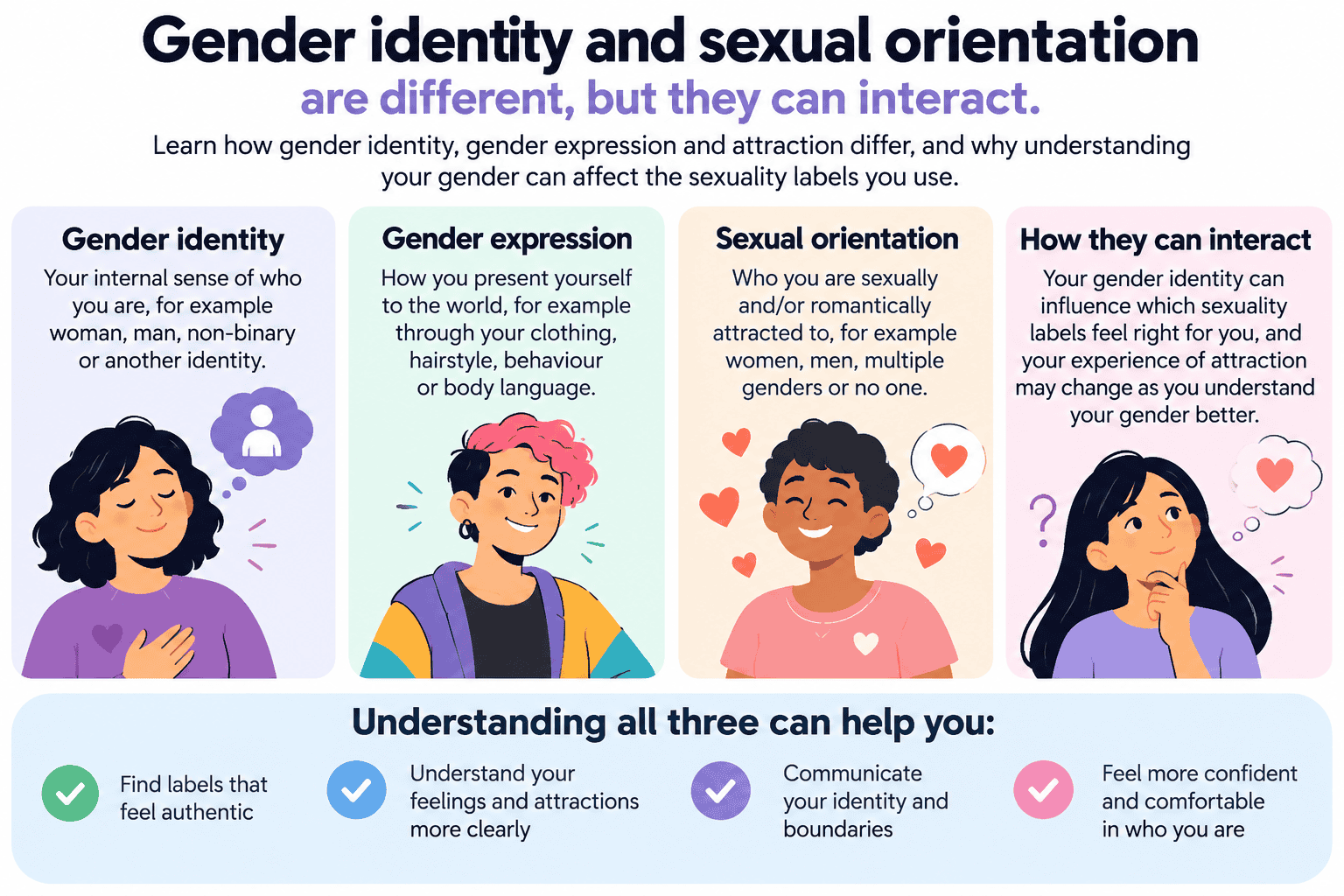
Gender identity describes your internal sense of your own gender.
Someone may identify as a woman, man, non-binary person, or use another term that better describes their experience. A person’s gender identity may or may not be the same as the sex they were assigned at birth.
Gender identity is therefore about who you understand yourself to be. It does not tell us who you are attracted to.
What is sexual orientation?
Sexual orientation describes patterns of emotional, romantic, and/or sexual attraction to other people.
Words such as bisexual, straight, gay, lesbian, pansexual and asexual can help people describe different experiences of attraction.
Sexual orientation is separate from gender identity. Knowing that someone is a man, woman or non-binary person does not by itself tell you their orientation.
What about gender expression?
There is another concept that can easily become mixed into the conversation: gender expression.
Gender expression is how someone presents or expresses aspects of gender outwardly. This can include clothing, hairstyle, voice, mannerisms and other parts of appearance or presentation.
Gender expression does not reliably tell you either someone’s gender identity or sexual orientation. A masculine-presenting woman is not automatically lesbian. A feminine-presenting man is not automatically gay. And someone whose appearance does not fit conventional expectations is not automatically transgender or non-binary.
Appearance is not a reliable sexuality or gender test.
Does being transgender determine your sexual orientation?
No.
Being transgender describes gender identity, not sexual orientation. Trans people can be straight, gay, lesbian, bisexual, pansexual, asexual, queer, or use other language.
The same basic principle applies to cisgender people: knowing someone’s gender does not tell you who they are attracted to.
This distinction also helps explain why being attracted to a trans person does not automatically require a different sexual-orientation label. We explore that misconception further in Bisexuality, Trans People and Non-Binary Inclusion: What “Bi” Actually Means.
Does being non-binary determine your sexual orientation?
No. Non-binary describes a gender identity or a broader group of gender identities, not one particular sexual orientation.
A non-binary person may identify as bisexual, gay, lesbian, straight, pansexual, asexual, queer, or use another term. Some non-binary people also identify as transgender, while others do not.
There is no single sexual orientation that follows automatically from being non-binary.
Can understanding your gender change your sexuality label?
It can change the language someone uses for their sexuality.
Many orientation labels describe attraction partly in relation to your own gender. That means understanding your gender differently can sometimes make an old label feel less useful and another one feel more accurate.
For example, someone may have understood themselves and their relationships through one gender identity for years. After recognising that they are trans or non-binary, they may reconsider whether words such as straight, gay, lesbian, bisexual or queer still describe them in the way they want.
That does not necessarily mean their underlying attractions suddenly changed. Sometimes the reference point used to describe those attractions changed.
Can attraction itself change or become clearer too?
For some people, yes.
It would be too simple to assume that every change in sexuality language is only a change of words. People may also discover, explore or understand attraction differently as they learn more about themselves.
The American Psychological Association notes that some transgender people report new exploration or changes in partner attraction during transition. That does not mean transition automatically changes sexual orientation. Experiences vary from person to person.
For one person, the attractions may feel essentially the same while the label changes. For another, both gender and sexuality may become clearer together. Someone else may notice no meaningful change in their orientation at all.
Why do gender identity and sexual orientation get confused?
Part of the confusion comes from the way LGBTQ+ identities are often grouped together. Gender and sexuality can both be important parts of identity and community, but sharing an acronym does not make them the same concept.
Another source of confusion is that some orientation words depend partly on gender. Words such as gay, lesbian and straight can describe attraction in relation to the gender of the person using the label.
That creates a connection between the language of gender and the language of sexuality without making gender identity and sexual orientation interchangeable.
Does someone’s appearance tell me their gender or sexuality?
No. Clothing, hairstyle, voice, body, mannerisms and masculinity or femininity are not reliable ways to determine someone’s gender identity or sexual orientation.
That applies to bisexual people too. There is no bisexual appearance, just as there is no single way for a trans or non-binary person to look.
If someone shares their identity with you, their own language is a better guide than assumptions based on appearance.
What if I am questioning both my gender and my sexuality?
You do not have to solve both questions at the same time.
You may feel confident about your attraction while still questioning your gender. You may understand your gender but remain uncertain about your sexuality. Or both may be developing together.
It is also okay to use a label provisionally, change it later, use broader language such as queer or questioning, or decide that you do not need a precise label right now.
A label can describe what you currently understand about yourself. It does not have to predict everything you will understand in the future.
Gender identity and sexual orientation are different — but both can be part of your story
The simplest distinction is useful: gender identity describes your own sense of gender, while sexual orientation describes patterns of attraction.
Gender expression is another layer again: how someone presents or expresses gender outwardly.
Keeping those concepts separate prevents assumptions such as believing that being transgender determines someone’s sexuality, that being non-binary requires one particular orientation label, or that someone’s appearance reveals who they are attracted to.
But separate does not mean unrelated in every person’s life. Understanding your gender may affect how you describe your attraction, and both parts of yourself can become clearer over time.
How have other people experienced this?
BiFiles has a Forum discussion specifically for this question: Has Understanding Your Gender Ever Changed How You Describe Your Sexuality?
You can read quietly or share whether understanding your gender changed your attractions, mainly changed the label you use, or did not change your orientation at all.
If your question is specifically about bisexuality and trans or non-binary inclusion, read Bisexuality, Trans People and Non-Binary Inclusion. If you are trying to understand the overlap between bisexual and pansexual, see Bisexual vs Pansexual: What’s the Difference — and Does It Matter?
For a shorter explanation, explore the Trans, Gender & Bisexuality FAQ, including questions about gender identity, sexual orientation and changing labels.