Attracted to a Trans or Non-Binary Person: What Does It Mean for Your Sexuality?

Being attracted to a trans person can raise unexpected questions about your sexuality, especially when a label that once felt simple suddenly feels much less certain.
You might have thought of yourself as straight, gay, lesbian, bisexual, pansexual, or something else for years. Then you find yourself attracted to a trans or non-binary person and start wondering what that attraction means about you.
Does it change your sexual orientation? Does it mean you are bisexual or pansexual now? Does the other person’s gender, body, or trans status determine which label you should use?
The short answer is: being attracted to one trans or non-binary person does not automatically assign you a new sexual-orientation label. It may give you new information about your attraction, and it may lead you to understand yourself differently. But sexuality is not a formula in which one person automatically produces one label.
Does one person change your sexual orientation?
One unexpected attraction can absolutely make you question how you understand your sexuality. That does not mean you have to reach an immediate conclusion.
Sexual orientation is broader than one isolated moment. It can involve patterns of romantic, emotional, and sexual attraction, as well as the identity or language someone uses to describe themselves. Attraction, behavior, and identity are related, but they do not always line up in one simple way.
That means a new attraction can be meaningful without functioning as an automatic label test.
For one person, an unexpected attraction may eventually become part of recognising a broader pattern they had not noticed before. For someone else, it may remain unusual within an otherwise stable pattern of attraction. Another person may decide that their old label still works perfectly well.
None of those outcomes has to be decided on the day you first notice someone.
Being trans is not a separate sexual orientation category
A common source of confusion is treating “trans” as though it were a separate gender category that sits outside men and women.
It does not work that way. A trans woman is a woman, and a trans man is a man. Being transgender describes a relationship between someone’s gender identity and the sex they were assigned at birth; it does not tell you their sexual orientation.
Trans people can themselves be straight, gay, lesbian, bisexual, pansexual, asexual, queer, or use other language for their sexuality.
This is also why finding a trans person attractive does not automatically move your sexuality into a special “trans-attracted” category.
If this distinction is new to you, start with Gender Identity vs Sexual Orientation: What’s the Difference?
What if the person is non-binary?
Non-binary can make the question feel less straightforward because traditional labels such as straight, gay, and lesbian developed largely around categories such as men and women.
Non-binary is also a broad umbrella. Non-binary people do not all understand or express their gender in the same way, and you cannot determine everything about someone’s gender, body, or relationships simply from knowing that they are non-binary.
Being attracted to a non-binary person therefore does not automatically make you bisexual, pansexual, gay, straight, or any other orientation.
It may make you think more carefully about what your existing label means to you. Perhaps your label still describes your broader pattern of attraction well. Perhaps another label starts to feel more accurate. Perhaps you become less interested in finding a precise label at all.
The important distinction is between noticing an attraction and deciding how you understand your overall sexuality.
Does attraction to a trans or non-binary person mean you are bisexual or pansexual?
Not automatically.
Bisexuality is commonly understood as the capacity for attraction to more than one gender. Pansexuality is commonly used for attraction to people of any gender or attraction in which gender is not a defining limit. There is real overlap between those identities, and people with similar attractions may choose different labels.
Neither label exists simply to mean “attracted to trans people.” Bisexuality does not inherently exclude trans or non-binary people, and pansexuality is not required simply because someone you find attractive is trans or non-binary.
For a fuller explanation, read Bisexual vs Pansexual: What’s the Difference — and Does It Matter? and Bisexuality, Trans People and Non-Binary Inclusion: What “Bi” Actually Means.
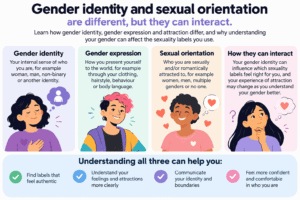
Attraction, behavior and identity are not exactly the same thing
It can help to separate several questions that often get compressed into one:
- What is this person’s gender?
- What kind of attraction am I experiencing toward them?
- Are particular physical characteristics part of that attraction?
- Does this fit a broader pattern I recognise in myself?
- What sexual-orientation label, if any, feels accurate to me?
Those questions can influence one another, but they are not interchangeable.
You can experience attraction before you know what language you want to use for it. You can have a sexual or romantic experience without deciding that the experience permanently defines your identity. And you can use an orientation label without having dated or had sex with every gender included in your potential attraction.
This is one reason why another person usually cannot calculate your sexuality from the outside simply by looking at who you date.
What if particular physical characteristics matter to my attraction?
Attraction can involve many things: someone’s gender, face, body, voice, style, personality, masculinity, femininity, emotional connection, chemistry, or particular physical characteristics.
People do not all experience those elements in the same way.
Recognising that a particular characteristic matters to you does not require pretending that gender and bodies are identical concepts. It also does not give us a universal formula for determining sexual orientation from individual body preferences.
You may learn something useful about your attraction by noticing what draws you to someone. You do not have to turn every detail into an immediate identity verdict.
What about genital preferences and sexual compatibility?
Physical and sexual compatibility can matter in dating and relationships. People can have boundaries or preferences around bodies, sexual activities, fertility, relationship goals, and the kinds of intimacy they want.
Having a boundary does not mean you owe anyone attraction, sex, or a relationship.
At the same time, it is worth avoiding assumptions about an individual person’s body simply because they are trans or non-binary. Trans people do not all have the same anatomy, transition history, medical choices, sexual interests, or boundaries.
There is therefore an important difference between saying, “This particular form of sexual compatibility matters to me,” and assuming, “I already know everything relevant about this person’s body because they are trans.”
Compatibility is something you discover between actual people. A group label cannot tell you every private detail about an individual.
Attraction is not the same as fetishizing someone
Being attracted to someone who is trans or non-binary is not inherently fetishizing them.
The problem begins when a person is reduced mainly to their trans status, a presumed body, or a sexual fantasy about what trans people are supposed to be like.
Someone can be attracted to a trans person while still seeing them as a whole person with their own gender, personality, preferences, boundaries, and reasons for dating or not dating.
Respect also means not expecting someone to explain intimate details about their body simply because you are curious about trans people.
What if I’m attracted to a trans person unexpectedly?
An unexpected attraction can challenge assumptions you did not realise you were making.
You do not need to shame yourself for being surprised. But it can be useful to ask what exactly surprised you.
Was it the person’s gender? Their trans status? Something you had assumed about trans bodies? Or simply the fact that this person did not fit the pattern you expected from yourself?
“Trans” alone does not tell you everything about someone’s appearance, body, personality, or compatibility with you. Sometimes meeting a real person exposes how broad an assumption had become.
What if this attraction genuinely changes how I understand myself?
That can happen too.
Saying that one attraction does not automatically change your label is not the same as saying that a new attraction can never matter.
You might realise that the attraction is part of a broader pattern. You might remember earlier feelings differently. A label that once felt accurate may start to feel too narrow, or another word may finally describe something you had struggled to explain.
If bisexual, pansexual, queer, questioning, or another label eventually feels more accurate, you are allowed to use it.
You are also allowed to keep the label you already use if it still describes your experience well.
A changing label does not necessarily mean you were lying before. Sometimes the language changes because your understanding of yourself has become more complete.
You do not need to solve your sexuality immediately
Questions about sexuality often become harder when you feel that every attraction needs an immediate explanation.
It is okay to begin with something much simpler:
I am attracted to this person.
You can notice that without immediately deciding what it proves.
Over time, you may see a broader pattern. You may choose different language. Or you may discover that the label you already had still works.
Your sexuality does not need to be calculated for you by friends, partners, strangers, or people online. A label can help describe your experience, but it does not need to become a rule that prevents you from noticing what you actually feel.
Talk about it with other people
If an unexpected attraction has ever made you reconsider your sexuality, you are not the only person to have wrestled with the question.
Join the BiFiles Forum discussion: Has Attraction to a Trans or Non-Binary Person Ever Made You Question Your Sexuality?
You can share whether you changed your label, kept it, stopped worrying about labels, or are still figuring out what the attraction means. Share only what feels comfortable.
Related BiFiles guides
- Trans, Gender & Bisexuality — Support & FAQ
- Bisexuality, Trans People and Non-Binary Inclusion: What “Bi” Actually Means
- Bisexual vs Pansexual: What’s the Difference — and Does It Matter?
- Gender Identity vs Sexual Orientation: What’s the Difference?
- Do I Need a Bisexual Label?
- Am I Bisexual?
Sources and further reading
This article separates sexual orientation, gender identity, attraction, behavior, and self-identification using established LGBTQ+ terminology and research guidance.
- National Academies of Sciences, Engineering, and Medicine — Measuring Sex, Gender Identity, and Sexual Orientation
- American Psychological Association — Understanding Transgender People, Gender Identity and Gender Expression
- APA Dictionary of Psychology — Sexual Orientation
- Human Rights Campaign — Glossary of Terms
Language around gender and sexual orientation continues to develop. Individual people may use identity terms differently, and respectful self-identification should take priority over trying to assign someone a label from the outside.