When the Bi-Cycle Feels Intense: Do You Have to Act on It?

Sometimes a shift in attraction is easy to notice and easy to live with. At other times, it can feel so strong that it takes over your attention.
You may suddenly think much more about a particular gender, notice people you had barely been noticing before, have stronger fantasies or dreams, or feel a kind of longing that seems difficult to ignore.
For some bisexual people, this is described informally as the bi-cycle: periods when attraction toward different genders seems to become stronger, weaker, or more noticeable over time.
When that shift becomes intense, the difficult part is often not the attraction itself. It is everything you start asking yourself because of it.
Does this mean I was wrong about being bisexual? Am I actually gay or lesbian? Am I becoming straight? Do I need to experience this attraction in real life? What if I am already in a relationship?
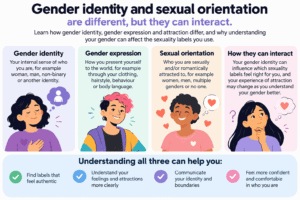
Strong feelings can create a sense that you need an immediate answer. But attraction, identity, and action are three different things.
What does an intense bi-cycle feel like?
There is no single bisexual experience, and “bi-cycle” is a community term rather than a medical diagnosis. People use it to describe changes in which attractions feel most present at a particular time.
An intense shift might mean that attraction toward one gender becomes unusually noticeable for days, weeks, or longer. Someone you would normally notice casually may suddenly hold your attention much more strongly. Fantasies may become more frequent. You might begin thinking about experiences you have never had, or experiences you have not had for years.
Sometimes the contrast is what makes the experience feel alarming. If attraction toward one gender becomes stronger while attraction toward another feels quieter, your brain may interpret that difference as evidence that something fundamental has changed.
But bisexuality has never required attraction to different genders to remain equal, simultaneous, or perfectly consistent.
If the broader question is whether changing attraction can still fit within bisexuality, see Am I Bisexual If My Attraction Changes Over Time?. This article focuses specifically on what happens when that change feels unusually intense or urgent.
Strong attraction does not automatically require a new label
One of the easiest traps is treating your strongest feeling today as a final verdict on your entire orientation.
If you are strongly focused on men right now, you may start reviewing every past attraction to women. If women suddenly dominate your attention, you may start wondering whether previous attraction to men was ever genuine.
That kind of retrospective checking can make uncertainty grow rather than disappear.
Your current attraction matters, but it does not automatically cancel everything you have experienced before. Neither does an earlier bisexual label require you to keep using it forever if another description eventually feels more accurate.
The important point is that you do not need to decide immediately.
A label can describe what you understand about yourself without functioning as a contract that has to be defended every time your attraction changes.
Do you have to act on an intense bi-cycle?
No. Feeling something strongly does not create an obligation to act on it.
Attraction can be real without becoming behaviour.
You can notice someone, fantasise, feel curious, experience longing, or recognise that a part of your sexuality has become much more visible without needing to date someone, have sex, change your relationship, or prove anything about yourself.
This distinction can be especially important when the feeling is intense enough to create urgency.
“I really want this” and “I must do this now” are not the same statement.
Giving yourself some space can help you understand whether the feeling is primarily about sexual experience, romantic connection, curiosity, recognition, community, freedom, novelty, or simply finally allowing yourself to notice an attraction you previously pushed aside.
What if you have never explored that side of your attraction?
An intense bi-cycle can feel particularly significant when it involves experiences you have never had.
Someone who has only dated men may suddenly become much more aware of attraction to women. Someone who has spent years in same-gender relationships may suddenly notice strong attraction toward another gender. A bisexual person who recognised their identity later in life may feel that they have somehow “missed” something.
That can turn curiosity into pressure:
- How will I know unless I try?
- Am I really bisexual if I have never experienced this?
- What if I regret never exploring it?
- What if the feeling gets stronger?
Experience can teach you things about yourself, but it is not a qualification you have to earn before your attraction counts.
You are also allowed to remain curious without immediately converting curiosity into an experience.
What if you are already in a relationship?
This is often where an intense shift becomes emotionally complicated.
You may love your partner and still suddenly notice another part of your attraction much more strongly. Those facts are not automatically contradictory.
Being bisexual does not mean that every attraction has to be pursued, just as being attracted to more than one person does not automatically mean a monogamous relationship is impossible.
If the feelings are affecting your relationship, the useful question may be less “How do I make this attraction disappear?” and more “What is this bringing up for me?”
For some people, what they need is simply space to acknowledge that the attraction exists. Others may want more openness in conversations about sexuality. Some realise they are missing queer or bisexual community rather than another sexual partner. Others may genuinely want to discuss whether existing relationship agreements still fit.
None of those possibilities automatically determines what you or your partner should agree to. Relationship boundaries still require mutual consent.
Try separating attraction, curiosity, desire, and action
When everything feels urgent, it can help to separate several questions that are easy to blend together:
- What am I noticing? Attraction, fantasies, romantic interest, curiosity, longing?
- What feels new? The attraction itself, or how much attention I am giving it?
- What do I want? Recognition, information, connection, fantasy, dating, sex, community, or simply permission to feel it?
- What would acting on it affect? My wellbeing, privacy, safety, relationship agreements, or other people?
- Do I actually need a decision today?
Sometimes just separating those questions lowers the pressure.
You can want something without promising yourself you will pursue it. You can be curious without testing yourself. And you can recognise a change without immediately turning it into a new identity.
Constantly checking your attraction can make things harder
When uncertainty becomes uncomfortable, it is tempting to keep checking.
You may look at people and ask yourself whether you feel enough attraction. Compare today’s reaction with yesterday’s. Replay previous relationships. Search for certainty in fantasies, pornography, crushes, or imagined situations.
The problem is that constant testing can make every small fluctuation feel important.
Instead of helping you notice attraction naturally, you may end up watching yourself so closely that you cannot tell what feels spontaneous anymore.
Sometimes clarity comes from allowing the uncertainty to exist for a while rather than demanding that every feeling immediately explain who you are.
An intense bi-cycle may be telling you something without telling you what to do
Strong attraction is still information.
It might help you recognise something you have ignored. It might show you that bisexual visibility or community matters more to you than you realised. It might reveal curiosity you want to explore someday. It may lead to a useful conversation with a partner. Or it may simply be a period of attraction that becomes quieter again.
You do not have to know which explanation is correct immediately.
The goal does not have to be eliminating uncertainty. It can simply be understanding yourself well enough that urgency does not make the decision for you.
You can give attraction time without ignoring it
There is a difference between suppressing an attraction and choosing not to act immediately.
You can acknowledge what you are feeling. Write about it privately. Read other bisexual people’s experiences. Talk with someone you trust. Spend more time around bisexual or queer community. Notice what continues to matter after the initial intensity settles.
If you eventually decide that you want to explore something, that can be a considered choice rather than a test you felt forced to pass.
And if you decide that experiencing the attraction internally is enough, that is also a valid outcome.
The bi-cycle does not get to make your decisions for you
An intense shift in attraction can feel surprisingly powerful, particularly when it touches an unexplored part of your sexuality or reopens questions you thought you had already answered.
But intensity is not the same as instruction.
You can notice what is happening without immediately changing your label. You can take attraction seriously without acting on every attraction. And you can give yourself time to work out what the feeling means in the context of your actual life.
Bisexuality does not require perfectly balanced attraction. It also does not require you to prove every part of your attraction through experience.
How does an intense bi-cycle feel for you?
BiFiles has a dedicated community discussion about this question: When the Bi-Cycle Feels Intense, Do You Have to Act on It or Change Your Label?
You can read quietly or join the conversation if you want to share what an intense shift in attraction has felt like for you, whether it made you question your identity, and what helped you understand what you actually needed.